
AI + Dynamics 365: AI Should Solve a Business Problem, Not Simply Be Added
AI is becoming a standard part of enterprise platforms, including Microsoft Dynamics 365 (D365). But adding AI does not automatically create business value.
The more important question is: What business problem does AI solve?
In Dynamics 365 implementations, AI delivers the strongest value when it reduces manual development effort, accelerates customization, and makes enterprise data easier to find and use.
What Business Challenges Are Organizations Trying to Solve?
Organizations adopt Dynamics 365 to address common operational challenges such as:
- Manual and repetitive business processes that reduce productivity
- Siloed data spread across multiple systems and departments
- Slow access to critical business information
- Limited visibility into customer, financial, and operational data
- Delays in responding to changing business requirements
- Increasing pressure to do more with existing resources
Dynamics 365 helps address these challenges by bringing business processes, data, workflows, and applications into a connected platform. As organizations grow and their requirements become more complex, they often extend and customize Dynamics 365 to better support their unique business needs.
This is where AI can provide additional value, helping organizations accelerate customization, reduce development effort, and make enterprise information easier to access and use.
Where Does the Cost and Complexity of Dynamics 365 Implementation Come From?
Dynamics 365 provides much of the core functionality enterprises need out of the box, including databases, forms, workflows, and standard business processes.
The complexity often emerges in the final layer of implementation: customization.
Organizations frequently need to develop or modify:
- Scripts and business logic
- JSON configuration files
- Plugins and .NET-based applications
- Integrations with enterprise systems
- Business-specific workflows
These requirements traditionally depend on specialized Dynamics 365 developers. As customization grows, so can implementation timelines and costs.
For mid-market organizations that choose D365 partly for its flexibility and cost advantages, excessive customization can reduce those benefits.
This is where AI-assisted development can make a practical difference.
How Can AI Reduce Dynamics 365 Customization Effort?
AI can accelerate the code-heavy and repeatable parts of D365 development.
Development teams can use AI to assist with:
- Writing and adapting scripts
- Generating JSON configurations
- Building plugins and .NET components
- Accelerating repetitive development tasks
- Supporting code analysis and troubleshooting
Instead of replacing developers, AI reduces the mechanical work surrounding development, allowing specialists to spend more time on architecture, business logic, integrations, governance, and validation.
However, AI does not automate every aspect of Dynamics 365 customization.
Tasks such as drag-and-drop form building, UI changes, entity registrations, metadata refreshes, and platform-level configuration still require human involvement.
The practical value of AI today is therefore not eliminating customization. It is making the development-intensive portion faster and more efficient.
How Does Copilot Improve Access to Dynamics 365 Data?
Development is only one side of the opportunity.
As organizations bring sales, customer service, marketing, finance, and operational processes into Dynamics 365, finding the right information can become increasingly complex.
Microsoft Copilot enables users to interact with business information using natural language, helping them locate and understand relevant data without navigating multiple screens and records.
Organizations can extend this capability further through custom AI agents designed around specific business processes and integrated into the broader Microsoft ecosystem.
For business users, the outcome is straightforward: less time searching for information and more time acting on it.
Where Does AI Deliver the Most Value in Dynamics 365?
Across complex D365 environments involving sales, customer service, contact centers, marketing, product operations, integrations, and Azure services, AI is particularly valuable in two areas:
1. Development productivity: Reducing the time and effort required for custom development.
2. Information accessibility: Helping users find, understand, and act on enterprise data faster.
The value is not in adding AI everywhere. It is in identifying where manual effort, complexity, or information gaps are slowing the business down.
The CES Approach: Business Problem First, AI Second
At CES, we approach Dynamics 365 modernization by starting with the business problem rather than the AI feature.
For organizations already using D365, we assess existing customizations, integrations, workflows, data, and manual processes to identify where AI can deliver measurable improvements without unnecessarily disrupting business operations.
For organizations building a new Dynamics 365 environment, CES helps establish an AI-ready foundation that brings together Dynamics 365, Microsoft Azure, data, integrations, automation, Copilot, and AI capabilities around business outcomes.
Our Approach is Simple:
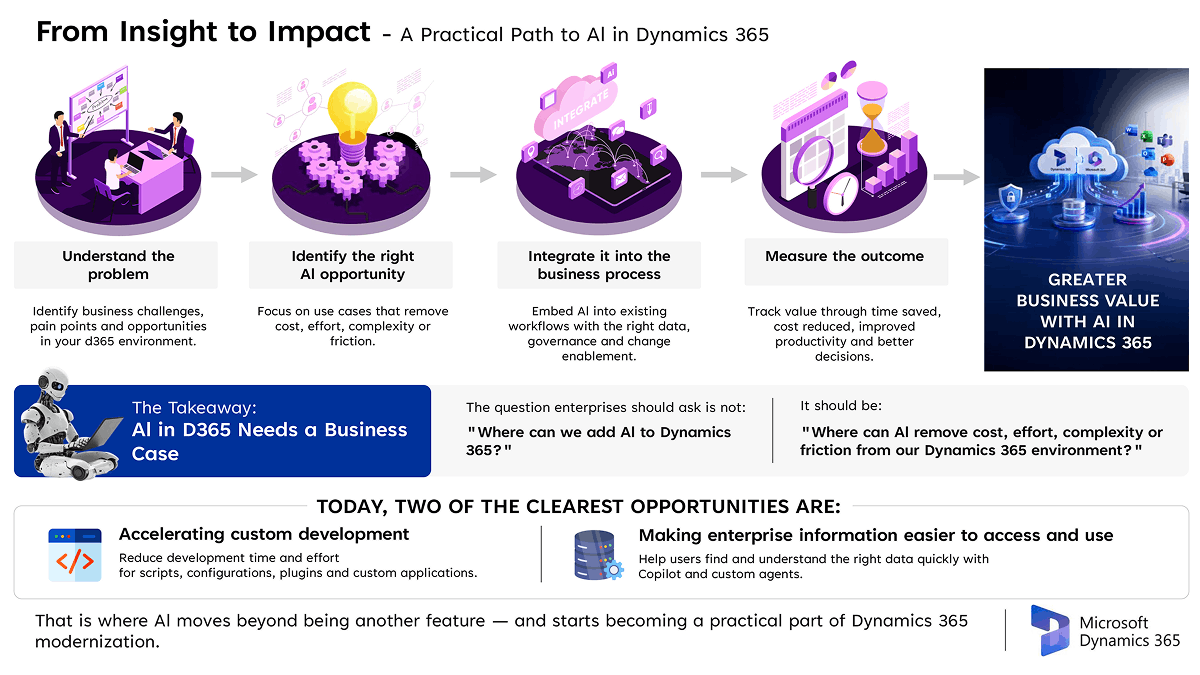
The Takeaway: AI in D365 Needs a Business Case
The question enterprises should ask is not:
“Where can we add AI to Dynamics 365?”
It should be:
“Where can AI remove cost, effort, complexity, or friction from our Dynamics 365 environment?”
Today, two of the clearest opportunities are accelerating custom development and making enterprise information easier to access and use.
That is where AI moves beyond being another feature—and starts becoming a practical part of Dynamics 365 modernization.
Exploring where AI can create measurable value in your Dynamics 365 environment?
Connect with CES at marketing@cesltd.com.

About the Author
Gopi Pitchai is a technical architect specializing in AI, with over 14 years of technology experience. At CES, he plays a key role in architecting and developing homegrown AI accelerators across multiple industries. His work focuses on applying AI to real-world business challenges, simplifying everyday workflows, improving productivity, and driving measurable outcomes.