
Your ERP is Live. Why Does Month-End Still Depend on Spreadsheets?
Your ERP is live. Transactions are flowing, invoices are being processed, and financial data is captured digitally.
Then month-end arrives, and finance teams are back in Excel.
Data is exported, reconciliation trackers are updated, entities are consolidated, formulas are checked, and multiple spreadsheet versions circulate across teams.
If this sounds familiar, there is a bigger question to ask:
If your ERP is live but your financial close still depends heavily on spreadsheets, has finance transformation really been completed?
Spreadsheets remain valuable tools for finance. The problem begins when they become the operating layer connecting processes that should already be controlled, automated, and visible within the ERP.
Why Does Month-End Close Still Depend on Spreadsheets?
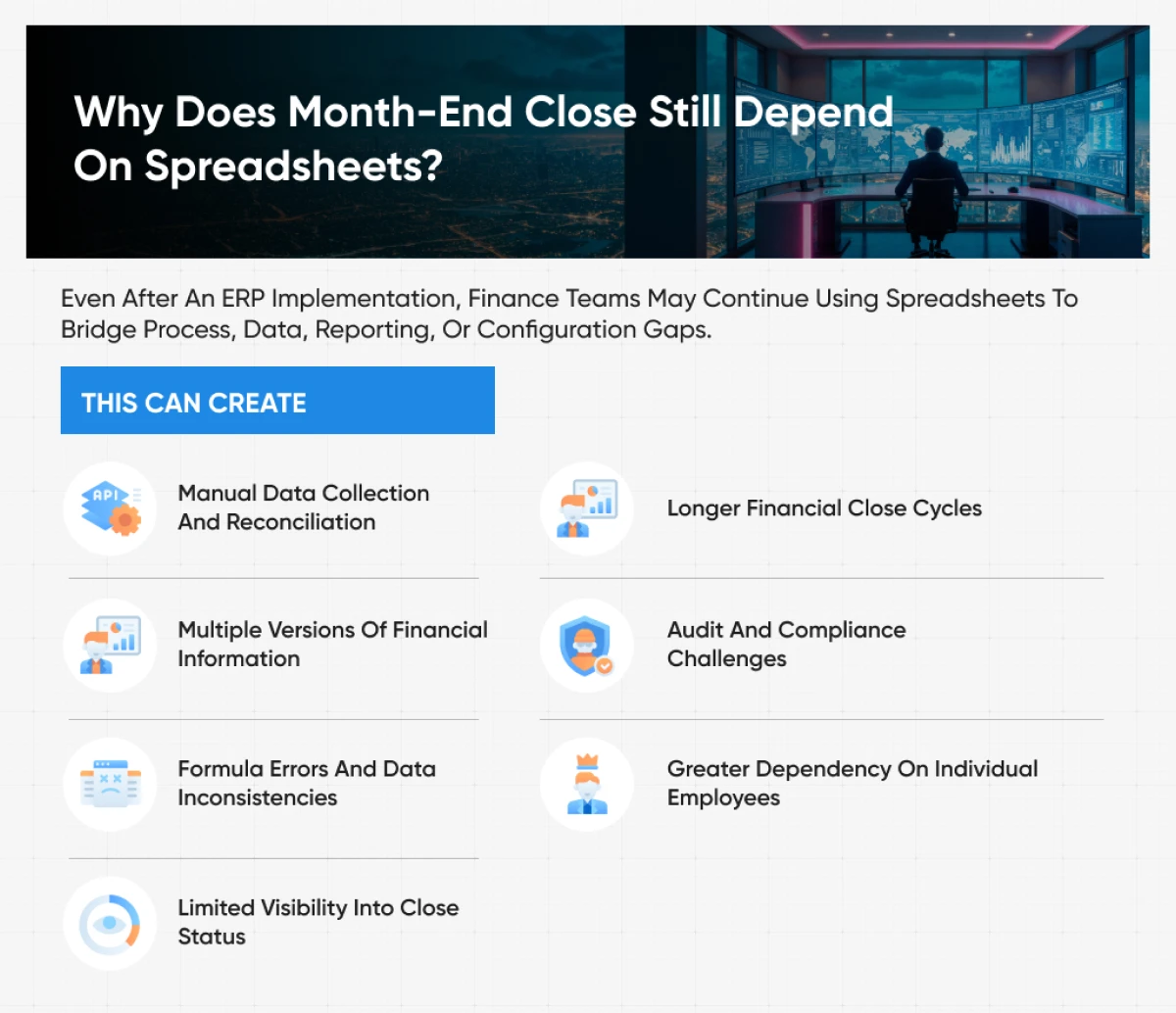
This can create:
- Manual data collection and reconciliation
- Multiple versions of financial information
- Formula errors and data inconsistencies
- Limited visibility into close status
- Longer financial close cycles
- Audit and compliance challenges
- Greater dependency on individual employees
Modern finance teams need more than accurate numbers. They need speed, control, traceability, and timely financial visibility.
This is where Microsoft Dynamics 365 Finance can help organizations move beyond spreadsheet-driven financial processes.
How Can Dynamics 365 Finance Improve Month-End Close?
Dynamics 365 Finance brings financial processes, controls, reporting, and data into a connected environment, helping organizations reduce manual effort across the close cycle.
Rather than spending significant time gathering and validating information, finance teams can focus more on exceptions, analysis, and business decisions.
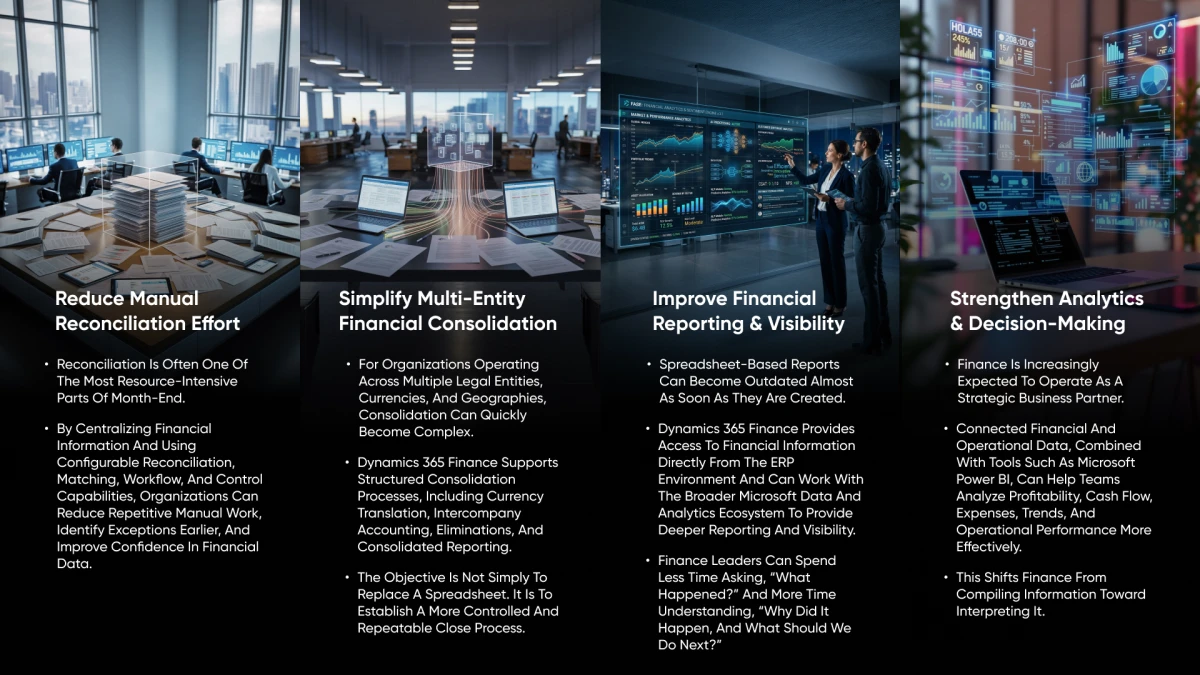
1. Reduce Manual Reconciliation Effort
Reconciliation is often one of the most resource-intensive parts of month-end.
By centralizing financial information and using configurable reconciliation, matching, workflow, and control capabilities, organizations can reduce repetitive manual work, identify exceptions earlier, and improve confidence in financial data.
2. Simplify Multi-Entity Financial Consolidation
For organizations operating across multiple legal entities, currencies, and geographies, consolidation can quickly become complex.
Dynamics 365 Finance supports structured consolidation processes, including currency translation, intercompany accounting, eliminations, and consolidated reporting.
The objective is not simply to replace a spreadsheet. It is to establish a more controlled and repeatable close process.
3. Improve Financial Reporting and Visibility
Spreadsheet-based reports can become outdated almost as soon as they are created.
Dynamics 365 Finance provides access to financial information directly from the ERP environment and can work with the broader Microsoft data and analytics ecosystem to provide deeper reporting and visibility.
Finance leaders can spend less time asking, “What happened?” and more time understanding, “Why did it happen, and what should we do next?”
4. Strengthen Analytics and Decision-Making
Finance is increasingly expected to operate as a strategic business partner.
Connected financial and operational data, combined with tools such as Microsoft Power BI, can help teams analyze profitability, cash flow, expenses, trends, and operational performance more effectively.
This shifts finance from compiling information toward interpreting it.
Does Dynamics 365 Finance Eliminate the Need for Excel?
Not necessarily, and that should not be the objective.
Excel remains useful for ad hoc analysis and modeling. The goal is to eliminate unnecessary spreadsheet dependency in business-critical financial processes.
When spreadsheets become the primary mechanism for reconciliations, consolidations, approvals, controls, or management reporting, organizations may not be realizing the full value of their ERP investment.
The CES Approach: Optimize the Process, Not Just the Platform
At CES, we look beyond whether Dynamics 365 Finance has been successfully implemented.
We assess how finance actually operates after go-live.
Our approach starts by identifying where manual interventions, spreadsheet dependencies, disconnected data, reporting gaps, and process bottlenecks remain across the financial close.
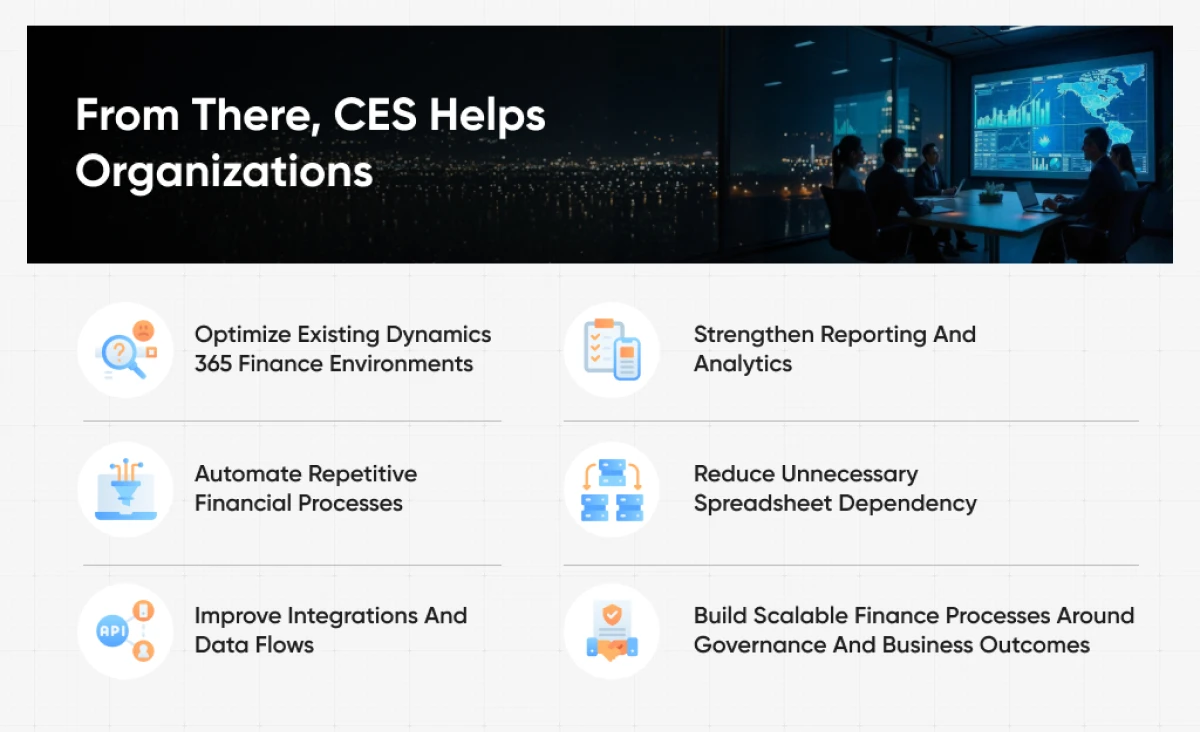
- Optimize existing Dynamics 365 Finance environments
- Automate repetitive financial processes
- Improve integrations and data flows
- Strengthen reporting and analytics
- Reduce unnecessary spreadsheet dependency
- Build scalable finance processes around governance and business outcomes
For organizations already running Dynamics 365, this means modernizing without unnecessarily disrupting critical finance operations. For organizations beginning their ERP journey, it means designing the right processes and controls into the foundation from the start.
The Takeaway: ERP Go-Live is Not the Finish Line
A successful ERP implementation should do more than digitize transactions.
It should transform how finance closes, controls, analyzes, and acts on financial information.
If month-end still requires extensive spreadsheet work, the opportunity may not be another ERP implementation. It may be getting more value from the Dynamics 365 environment you already have.
Still dealing with manual reconciliations, spreadsheet-driven consolidations, reporting challenges, and lengthy month-end close cycles?
Talk to CES about optimizing your Dynamics 365 Finance environment and building a faster, more connected and controlled financial close.
Connect with us: marketing@cesltd.com

About the Author
Sarita Rani Palo is an experienced Dynamics 365 Finance & Operations (D365 F&O) professional with 8 years of expertise in Finance module implementations, solution design, and business process transformation. Skilled in Finance & Accounting, Procure-to-Pay, Record-to-Report, Fixed Assets, Budgeting, and financial reporting. Proven track record of delivering end-to-end ERP implementations and driving digital transformation initiatives.