
i-Pulse: Stop Firefighting Oracle Integration Cloud Failures. Start Preventing Them
How do you effectively monitor and manage hundreds of live integrations running across the enterprise — every day, not just when something goes wrong?
Most organizations answer that question the hard way. Without daily, proactive monitoring, teams end up living with:
- Silent failures: Integrations fail quietly in the background until a business user notices missing data or a stalled process.
- Reactive firefighting: Support teams find out about problems from angry emails and escalations, not from their own tools.
- Compliance and revenue exposure: Delayed transactions and missed SLAs turn a technical hiccup into a business risk.
- Eroding trust: Every unnoticed failure chips away at the business’s confidence in Oracle Cloud and the teams that run it.
Introducing i-Pulse: Monitoring Built the Way Support Teams Actually Work
As an Offshore Capability Centre with extensive experience delivering Oracle Cloud programmes, we’ve designed and implemented numerous integrations in Oracle Integration Cloud (OIC) connecting Oracle Cloud Applications with a wide range of enterprise boundary systems – and we’ve felt these exact pain points alongside our customers.
That first-hand experience is what led us to build i-Pulse: A purpose-built Integration Monitoring Solution, powered by Oracle APEX and Oracle Visual Builder Cloud Service (VBCS), that replicates and enhances native OIC monitoring capabilities while delivering a genuinely business-friendly operational experience.
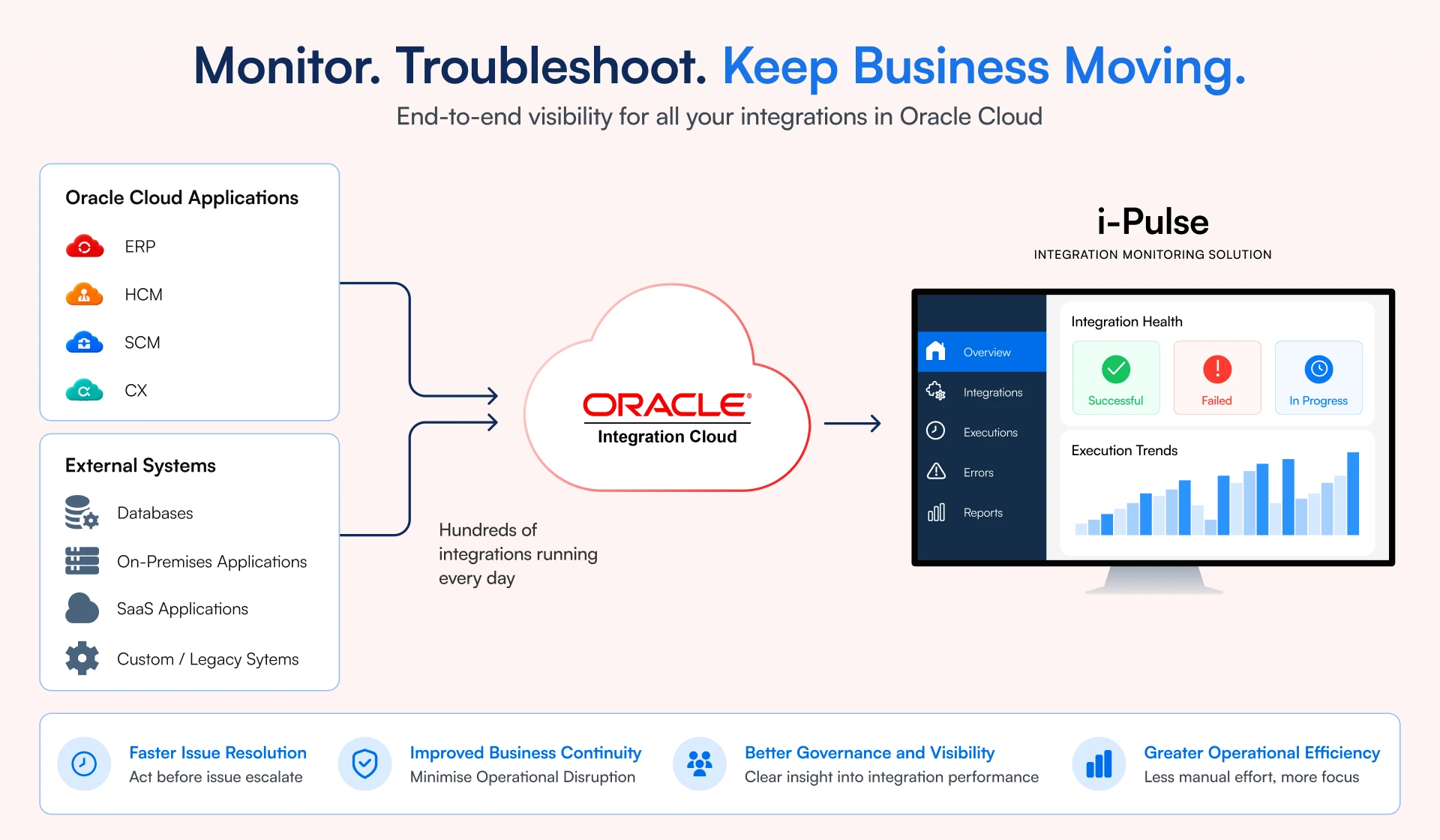
Instead of hunting across screens and reports after something breaks, i-Pulse gives support teams a single pane of glass to monitor integration health in real time — every day, not just on the bad ones.
What i-Pulse Does for You
- Real-Time Integration Monitoring: Monitor integration executions across multiple business processes from one dashboard. At a glance, support teams instantly see successful transactions, failed transactions, in-progress executions, performance metrics, and transaction trends and volumes.
- Intelligent Error Visibility: When failures do occur, i-Pulse captures and presents detailed error information in an easy-to-understand format – so analysts can quickly identify impacted integrations, review failure messages, understand affected systems, prioritize critical incidents, and accelerate root cause analysis.
The i-Pulse Advantage
The value of i-Pulse goes well beyond technical monitoring — it changes how the business experiences Oracle Integration Cloud.
- Reduced Mean Time to Resolution (MTTR): Support teams get immediate visibility into failures and can act faster, before issues escalate.
- Improved Business Continuity: Critical integration failures are caught before they create widespread operational impact.
- Enhanced User Experience: Business users experience fewer disruptions and shorter processing delays.
- Increased Operational Efficiency: Automation cuts the manual effort spent on monitoring, ticket creation, and incident triage.
- Better Governance and Visibility: Leadership gets clear insight into integration performance, recurring issues, and operational trends through executive dashboards and analytics.
Choose the Deployment That Fits Your Organization
Every organization approaches technology a little differently, so i-Pulse is available in two flavors built on the same core objective: actionable visibility into integration operations.
| Oracle APEX Dashboard | Oracle VBCS Dashboard |
|---|---|
| Rapid deployment | Modern Oracle Cloud-native user experience |
| Cost efficiency | Responsive web interfaces |
| Highly customisable monitoring experiences | Seamless Oracle ecosystem integration |
| Strong reporting and analytics capabilities | Enhanced cloud scalability |
What’s Next: Toward Self-Healing Integrations
Real-time monitoring is only the first step. We’re extending i-Pulse with AI-driven intelligence that will:
- Identify recurring error patterns automatically
- Predict failures before they occur
- Fetch detailed issue causes using AGI
- Recommend corrective actions
- Automate incident categorization
- Enable self-healing integration scenarios
The goal is simple: Move from support teams watching dashboards to integrations that flag, explain, and in many cases fix themselves.

About the Author
Vinay Alluri is vice president and head of the global development centre at CES. He leads global operations and transformation initiatives, helping organizations improve business performance through enterprise applications, cloud technologies, AI, and automation. With extensive experience delivering complex programs across industries and international markets, he focuses on driving operational excellence, scaling business processes, and translating technology investments into measurable business outcomes.