


Lumi
The memory-aware AI coworker for multi-agent teams
Are you struggling with token usage?
It's time to replace your token burner.
Lumi helps teams work with coordinated AI agents that can read codebases, retain context, and continue tasks across conversations inside a native desktop workspace. Built in Rust and GPUI, Lumi brings memory, workflows, analytics, and multi-agent execution into a single runtime.
One Runtime For Coordinated
AI Work

Coordinated agents
Run multiple AI agents inside shared team workflows with visible execution and structured coordination.

Persistent memory
Preserve observations, episodes, drafts, recall history, and knowledge structures across sessions.

Team workspaces
Separate conversations, memory, analytics, plans, and execution context by team.

AI personas
Assign specialized personas for engineering, writing, APIs, architecture, research, and workflows.

Sprint workflows
Coordinate epics, stories, tasks, and active workflows inside integrated sprint surfaces.

Execution analytics
Track turns, usage, token activity, audit visibility, and runtime behavior across teams.
Everything Connected In One Workspace
Lumi combines conversations, memory, execution, planning, analytics, and agent coordination inside a single desktop workspace.
With Bring Your Own AI (BYOAI), your data never leaves your designated perimeter, while a What You Configure Is What You Get (WYCIWYG) approach ensures execution follows the models, policies, and controls you define.
Chat
Lead conversations with streamed responses, attachments, live sub-agent visibility, & permission-aware interactions.
Cowork
Launch domain-specific workflows and reusable prompt flows through skill-driven execution surfaces.
Code
Browse repositories, inspect files, and review diffs directly inside the workspace.
Memory
Search observations, episodes, summaries, drafts, & knowledge structures with memory search & recall.
Design
Create design systems, interface concepts, and visual artifacts inside Lumi's private runtime.

Lumi
Analytics
Review token usage, audit visibility, execution behavior, and runtime activity across teams.
Sprint
Manage epics, stories, and tasks through integrated sprint and kanban-style workflows.
Agents
Manage active personas and teammate rosters inside the current team workspace.
Goal Execution
Continue working toward defined outcomes through adaptive execution that carries tasks to completion.
Settings
Configure governance controls, MCP servers, memory pipelines, budgets, directories, and runtime preferences.
Engineered for Production3B's

Built for
Long-running workflows
Lumi is structured for teams handling engineering, research, planning, and operational work that evolves over time. Teams can preserve memory across sessions, coordinate multiple agents, compare persona outputs, monitor execution activity, and continue work without rebuilding context every time.

Built on
MCP-native orchestration
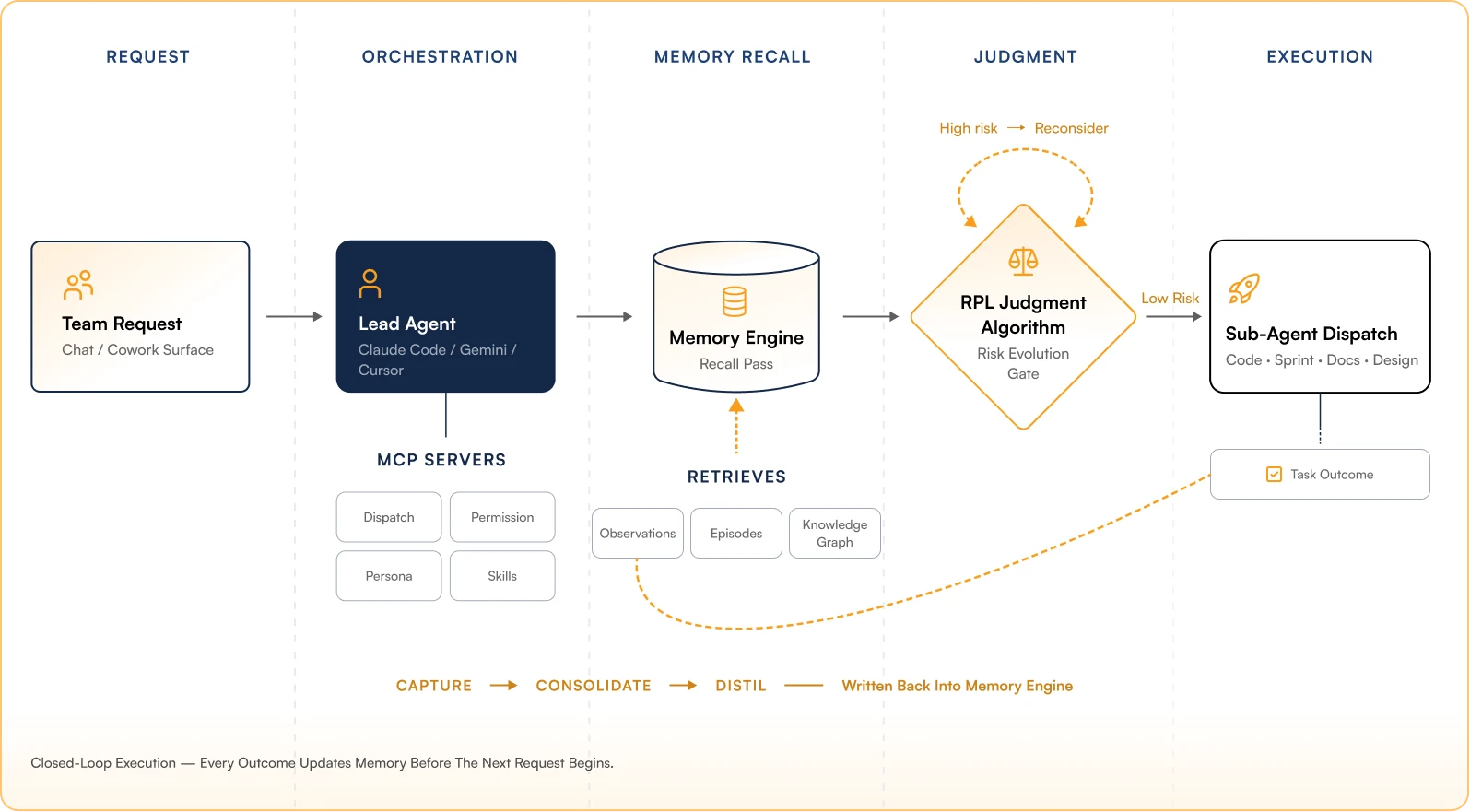
Lumi uses an MCP-native runtime model with in-process services for memory, permissions, dispatch, personas, sprint coordination, browsing, payload handling, and workflow execution. The runtime dynamically rebuilds MCP configuration based on the active workspace and team context.

Built with
Rust, GPUI and Apple MLX
Written in Rust and built on GPUI by Zed Industries, the runtime is designed around native desktop performance, structured state management, and GPU-accelerated interaction, with support for Apple MLX acceleration and coordinated multi-agent workflows. Lumi supports workflows across Claude Code, Gemini CLI, HERMES, Cursor, Crush, and MCP-compatible tooling.
Taking AI From
Pilot To Practice
Lumi helps organizations move from experimentation to sustained adoption by balancing agent autonomy with the oversight teams expect in real-world environments.
Guided
Autonomy
Enable agents to make progress independently while respecting the boundaries and expectations defined by your teams.
Shared
Visibility
Give stakeholders the context needed to understand how work unfolds and support informed decision-making.
Adaptive
Governance
Align execution practices with the needs of different teams, workflows, and operating models as requirements evolve.
Privacy by
Design
Keep work within your designated perimeter while deciding which models and services participate through a BYOAI approach.
Confidence to
Expand
Start with focused initiatives and extend adoption across teams as trust, familiarity, and operational maturity grow.
why lumi
Lumi means light.
The name reflects the way the platform was designed: attentive to context, aware of memory, and built for work that continues over time.
Lumi combines continuity with judgment. Its proprietary RPL Judgment Algorithm (Raskolnikov's Psychological Loop) evaluates high-risk actions before execution, helping agents reconsider risky paths and learn from outcomes over time.
Memory gives work continuity. Judgment gives it direction.
Lumi was designed to bring both together.