
AI Agents Can Do the Work. How Enterprises Manage Them at Scale
AI agents are quickly moving from interesting experiments to real business execution. They can review documents, summarize meetings, prepare reports, write code, process tickets, compare data, draft proposals, and move work from one step to the next with limited supervision.
That sounds like progress. But once agents begin touching real systems, customer data, internal files, approvals, and business workflows, a harder question appears. Who is watching the work? Who decides what the agent can access? Who checks whether the output is correct? Who steps in when the agent takes the wrong path?
This is where the agentic AI conversation becomes serious. Building an AI agent is only the first step. Managing a growing digital workforce is the real enterprise challenge.
One Agent Helps. Many Agents Need Discipline.
A single AI agent can be easy to understand. It may help a finance team check invoices, support an engineer with documentation, or assist a sales team with account research. The value is visible because the task is narrow, and the outcome is easy to review.
The picture changes when every department starts building agents of its own. Engineering has coding agents. Sales has proposal agents. HR has onboarding agents. Operations has workflow agents. Marketing has research agents. Finance has reconciliation agents. Each one may be useful, but together they create a new layer of work that needs structure.
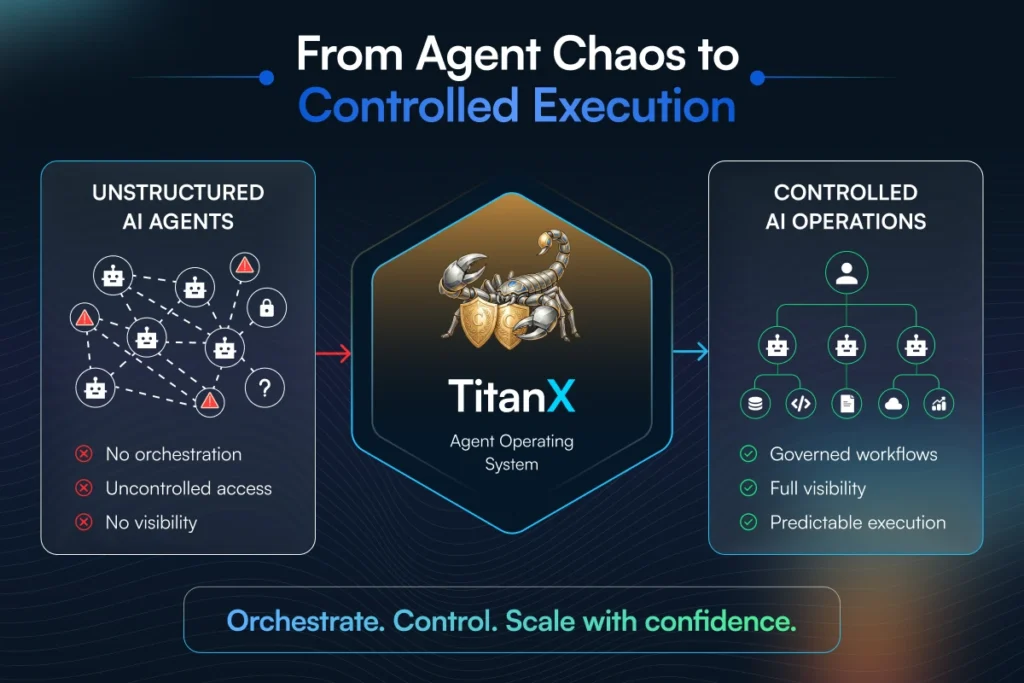
Without proper AI agent orchestration, organizations can quickly run into duplicate agents, unclear ownership, inconsistent outputs, unapproved tool usage, rising token costs, and security gaps. What began as automation can slowly turn into agent sprawl.
That is why the real question is not, “Can this agent complete a task?” The better question is, “Can this agent work safely inside our business?”
Why Agents Cannot Be Managed Like Regular Software
Traditional software behaves within fixed boundaries. A user takes an action, the system follows a defined rule, and the result is usually predictable. If something breaks, teams can inspect the code, trace the error, and fix the logic.
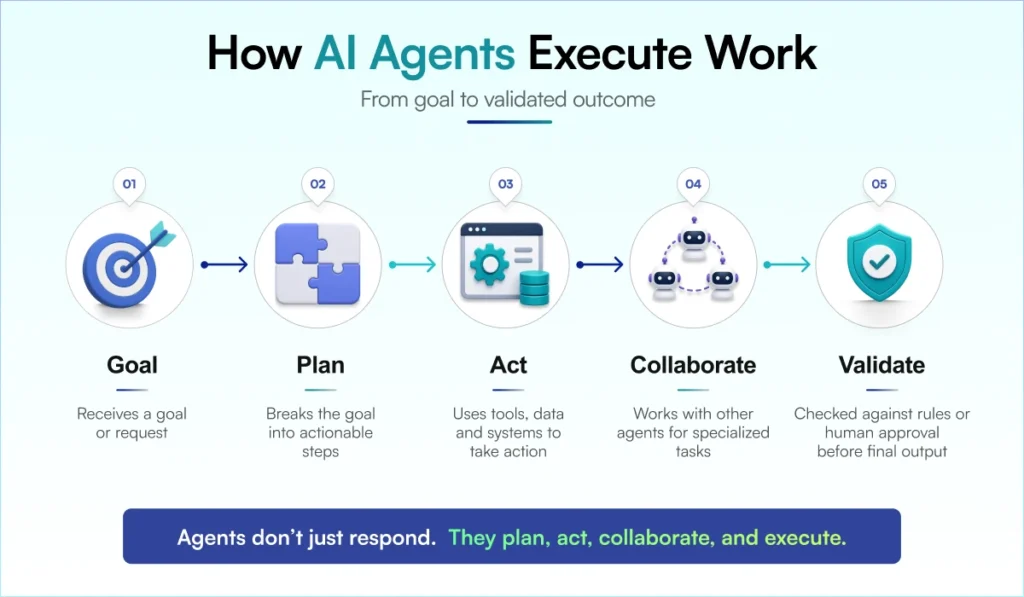
AI agents work differently. They interpret goals, break work into steps, retrieve context, select tools, call APIs, use memory, hand off tasks, and adjust their path as the work unfolds. Two agents may approach the same problem differently depending on the data, instructions, model behavior, tool access, and workflow design.
That flexibility is what makes agentic AI powerful. It is also what makes it harder to govern.
When an agent fails, the issue may not come from one obvious source. The problem could be weak context, outdated knowledge, excessive permissions, poor memory design, unclear escalation rules, or a workflow that never defined where the agent should stop. Standard logs are not enough for this kind of work. Teams need to see the agent’s plan, tool calls, handoffs, approvals, execution path, and cost behavior.
This is why agents require an operating model, not just deployment.
What Keeps a Digital Workforce Under Control
A reliable digital workforce needs more than prompts and model access. It needs clear rules, visible execution, and technical guardrails that hold up when agents begin operating across departments.
The most effective controls are practical and enforceable:
- Role clarity: Every agent needs a defined job, scope, toolset, owner, and escalation path. An agent without role clarity is fast, but risky.
- Orchestration: Multi-agent systems need coordination. A lead agent, specialist agents, approval steps, and fallback paths help keep work organized instead of scattered.
- Security: AI agent security should follow least-privilege access. Agents should not freely touch files, APIs, credentials, networks, or systems without runtime controls.
- Observability: Teams need visibility into what happened, why it happened, which tools were used, how long it took, and where the workflow failed.
- Cost discipline: Agents can quietly increase cost through long reasoning loops, repeated model calls, failed retries, and duplicated work. Cost control has to be part of the architecture.
These controls are what separate a useful agent demo from a system that can run inside a real enterprise environment.
The Real Risk Is Uncontrolled Action
Many AI discussions still focus on inaccurate answers. That concern is valid, but it does not capture the full risk. In enterprise settings, the bigger issue is uncontrolled action.
An unmanaged agent may pull the wrong document, use stale policy data, trigger the wrong workflow, expose sensitive information, or pass an incomplete result into another system. It may also continue retrying a task, consuming tokens and compute without producing meaningful value.
That is why agentic AI governance cannot be added at the end. It must be built into how agents are designed, deployed, monitored, and improved. Permissions, approvals, audit trails, memory, network access, and human review points all matter because agents are not just generating text. They are participating in work.
The more critical the workflow, the stronger the control layer needs to be.
Humans Still Lead. Agents Execute.
The best use of AI agents is not to remove people from the process. It is to remove avoidable drag from the process.
Human teams still define goals, set policies, approve sensitive actions, manage exceptions, assess quality, and improve workflows. Agents handle repeatable execution, information retrieval, task routing, documentation, analysis, and follow-through.
That balance matters. A digital workforce should not feel like a group of unsupervised bots running in the background. It should work more like a disciplined operating layer where humans stay in control while agents handle the heavy operational lift.
Teams move faster, but not blindly. Work gets automated, but not without accountability.
The Missing Layer Is Agent Operations
Most companies are already exploring AI agents across multiple functions. What they lack is the infrastructure to operate them responsibly.
They need a platform to build agents, assign roles, connect tools, enforce permissions, preserve context, monitor execution, approve sensitive steps, trace decisions, measure performance, and control costs. They also need a way for multiple agents to work together without creating confusion across systems and teams.
This is where an Agent Operating System like TitanX becomes essential. TitanX is designed to help enterprises create, orchestrate, monitor, secure, and scale AI agents across business functions. It brings multi-agent coordination, governed workflows, zero-trust security, observability, memory, approvals, and cost optimization into one structured environment.
AI agents can do the work. TitanX ensures that work happens within boundaries enterprises can trust.