
Smart Factory and OEE: The Data-Driven Future of Manufacturing
Manufacturing is entering a new era where operational success is increasingly defined by visibility, speed, and data-driven decision-making.
Today’s factories generate enormous amounts of operational data, yet many manufacturers still struggle to convert that information into measurable business outcomes. Machines run, systems collect data, and dashboards grow more complex — but leaders often lack clear insights into what is improving productivity and profitability.
This is where smart factories and Overall Equipment Effectiveness (OEE) are becoming essential.
For CTOs, COOs, plant leaders, and digital transformation executives, OEE is no longer just a manufacturing metric. It has become a strategic business indicator that helps organizations improve throughput, reduce downtime, optimize investments, and accelerate Industry 4.0 initiatives.
As manufacturers move toward AI-driven operations and connected ecosystems, smart factories powered by real-time OEE insights are reshaping the future of industrial performance.
What Is a Smart Factory?
A smart factory is a digitally connected manufacturing environment where machines, systems, sensors, and software continuously communicate and exchange operational data.
Unlike traditional factories that rely heavily on manual monitoring and reactive maintenance, smart factories use technologies such as:
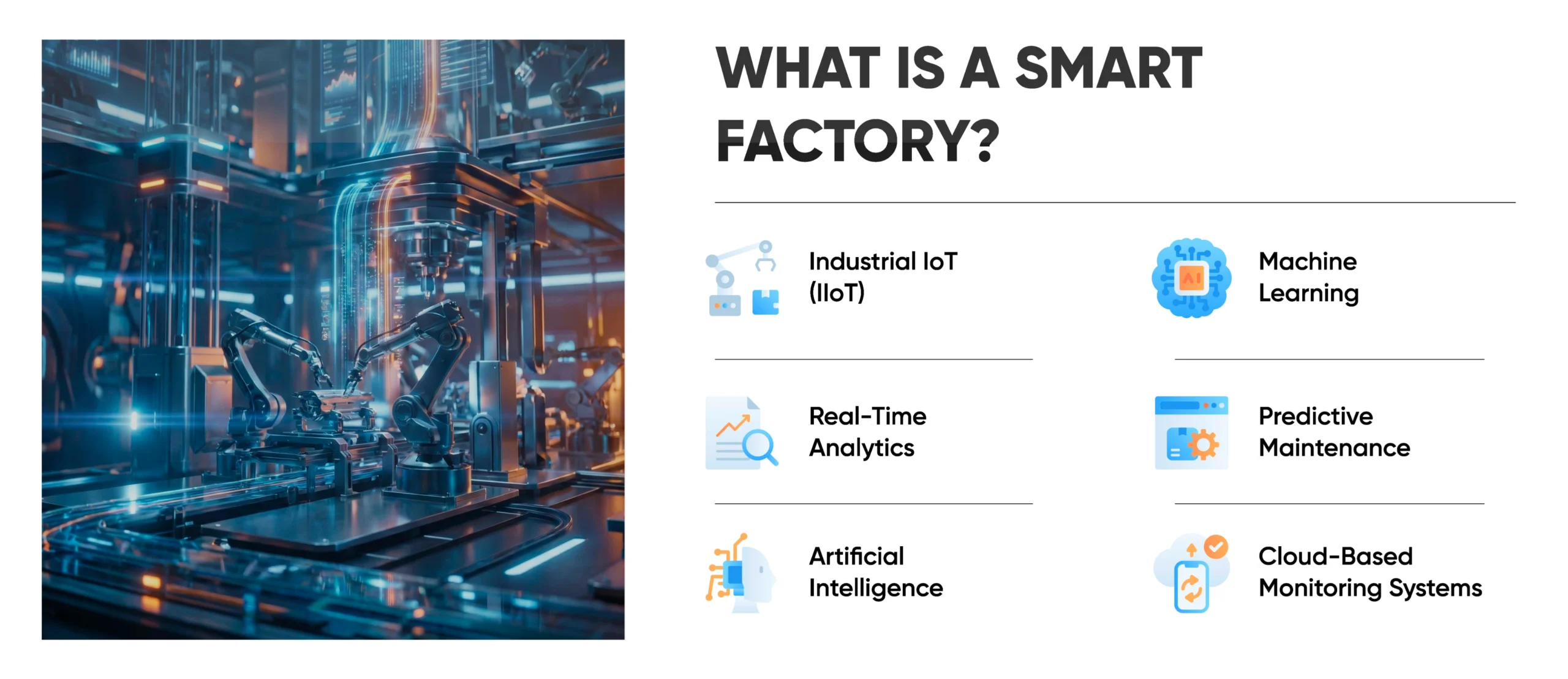
These technologies help manufacturers gain end-to-end visibility across production operations and make faster, evidence-based decisions.
The objective is not simply automation. It is operational intelligence.
Why OEE Matters in Smart Manufacturing
Overall Equipment Effectiveness (OEE) is one of the most important performance indicators in manufacturing.
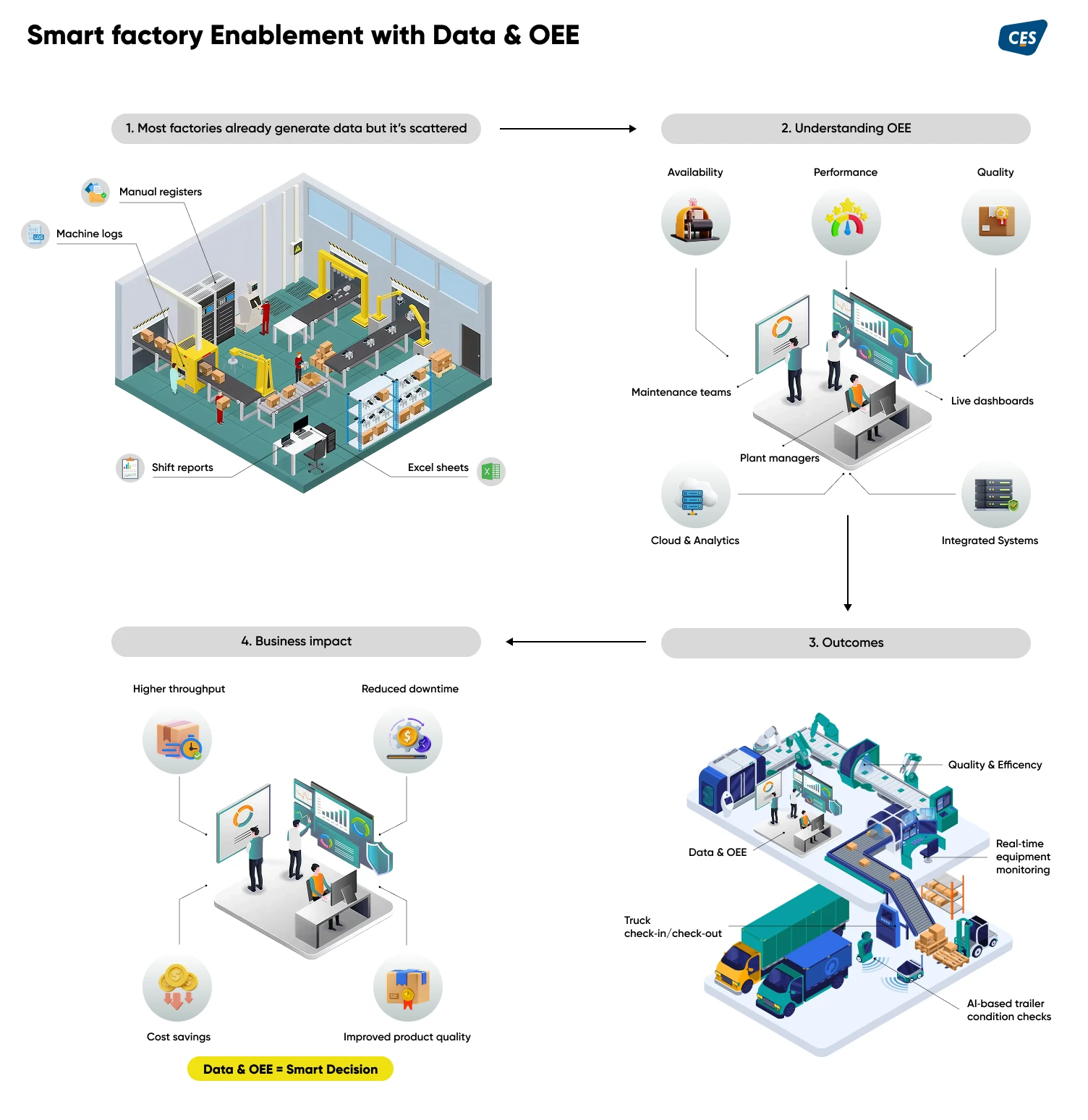
OEE measures how effectively equipment is utilized by evaluating three critical factors:
- Availability: How often machines are running without unplanned downtime
- Performance: Whether equipment is operating at optimal speed
- Quality: The percentage of defect-free products produced
When combined, these metrics provide a clear picture of production efficiency and operational health.
For manufacturing leaders, OEE acts as a real-time performance lens that exposes hidden inefficiencies affecting output, costs, and customer commitments.
The Business Challenges Traditional Factories Face
Many manufacturing facilities still operate with disconnected systems and limited visibility into machine performance.
Common challenges include:
Unplanned Downtime: Unexpected equipment failures disrupt production schedules, increase maintenance costs, and impact delivery timelines.
Limited Operational Visibility: Without centralized data, identifying production bottlenecks becomes difficult and reactive.
Inefficient Resource Utilization: Machines may appear operational while underperforming significantly below capacity.
Quality Inconsistencies: Lack of real-time monitoring can lead to increased defects, rework, and waste.
Slow Decision-Making: Production decisions are often based on assumptions rather than real operational data.
As global competition intensifies, these inefficiencies directly affect profitability, agility, and customer trust.
How Smart Factories Use OEE to Improve Performance
Smart factories transform OEE from a static KPI into a real-time operational intelligence system.
Connected sensors and industrial gateways continuously collect machine-level data and feed analytics platforms that provide actionable insights instantly.
This enables manufacturers to:
Detect Downtime Before It Escalates: Predictive analytics can identify early signs of equipment failure, allowing maintenance teams to act before production stops.
Optimize Production Throughput: Real-time monitoring helps plants improve machine utilization and increase output without investing in additional equipment.
Improve Product Quality: Continuous process visibility helps detect quality deviations early, reducing scrap and rework costs.
Accelerate Continuous Improvement: Production teams can identify recurring inefficiencies and implement targeted operational improvements faster.
Enable Data-Driven Leadership Decisions: Executives gain visibility into plant performance across locations, helping prioritize investments and operational strategies more effectively.
Business Impact Leaders Actually Care About
For technology leaders and business executives, smart factories are not simply operational upgrades. They are strategic growth enablers.
Organizations implementing smart manufacturing and OEE-driven optimization often achieve:
- Higher throughput without purchasing new machines
- Reduced downtime and maintenance expenses
- Improved production reliability and delivery commitments
- Better product quality and lower defect rates
- Faster returns from digital transformation investments
- Increased operational resilience and scalability
Most importantly, decisions move from intuition to evidence.
This shift toward data-driven manufacturing creates a stronger foundation for long-term competitiveness in an increasingly digital industrial landscape.
Frequently Asked Questions About Smart Factories and OEE
1. Is OEE only relevant for large manufacturing enterprises?
No. Small and mid-sized manufacturers often see faster gains because operational inefficiencies are easier to identify and correct.
2. Do manufacturers need new equipment to implement OEE tracking?
Not necessarily. Many legacy machines can be connected using industrial IoT sensors, gateways, and monitoring solutions without replacing existing infrastructure.
3. How quickly can manufacturers see results?
Many organizations begin uncovering actionable insights within weeks rather than years, especially when targeting high-impact production areas first.
4. Is smart factory transformation an IT initiative or an operations initiative?
It is both. The most successful smart factory programs are driven through collaboration between IT teams, operational leaders, and shop-floor personnel.
The Future of Manufacturing Is Data-Driven
A smart factory is not built overnight.
It is built incrementally one insight, one optimization, and one operational improvement at a time.
As machines become more connected and production data becomes more accessible, manufacturers gain the ability to act with greater speed, confidence, and precision.
In the era of Industry 4.0 and AI-powered manufacturing, organizations that leverage OEE and smart factory intelligence will be better positioned to scale operations, improve resilience, and stay competitive in a rapidly evolving industrial economy.
To explore how your manufacturing operations can accelerate digital transformation with smart factory solutions and OEE-driven insights, connect with our experts at marketing@cesltd.com.
Author – Rama Prasad Subramanian
Co-author – Saranya Gnanamani