
F&A AI Is Ready. Now Finance Workflows Need to Catch Up
Finance doesn’t have an AI problem. It has a workflow problem.
Most finance teams today already run on AI in some form. Forecasting models, invoice processing, reconciliation engines, reporting assistants – the stack is in place. The outputs are faster, more accurate, and more detailed than ever before.
Yet, when the numbers are reviewed at the end of the cycle, one thing becomes clear. Insights have improved. Execution hasn’t kept up. The system knows what needs attention, but the organization still takes time to respond. So, finance doesn’t struggle with insight. It struggles with what happens after it.
The Quiet Truth: AI Works Best Where Finance Is Already Structured
F&A AI performs best in areas where finance processes are already predictable and well-defined. These are workflows where data is structured, decisions follow repeatable logic, and exceptions are clearly understood. In such environments, AI doesn’t need to reshape the process. It simply accelerates it.
Accounts payable is a strong example. Invoice formats, purchase orders, tax rules, and vendor histories follow a consistent pattern, allowing accounting automation to operate smoothly. Reconciliation behaves the same way. Transaction matching is based on established rules which AI-powered systems can refine over time to improve accuracy.
Forecasting also benefits when financial and operational data are aligned across systems. Models can detect shifts in revenue, cost, or working capital early, but only when the underlying data flows are reliable.
These are not accidental successes. They work because the process itself is stable enough to support intelligence without friction.
The Real Breakdown Happens After the System Gets It Right
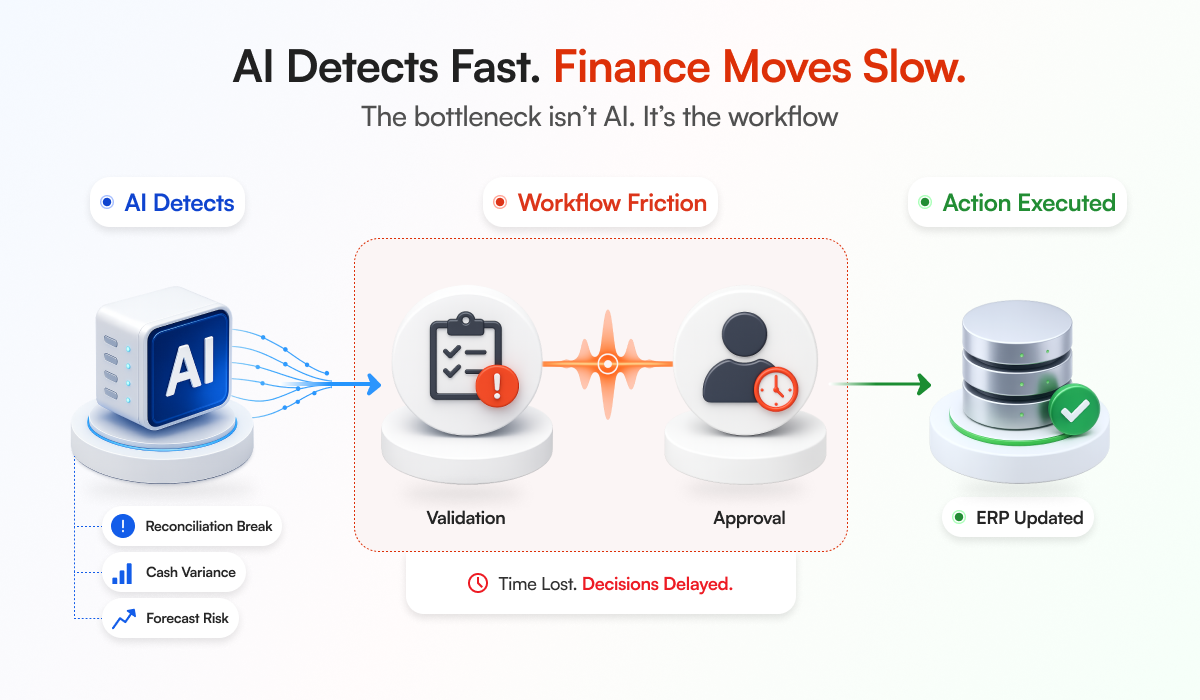
F&A AI performs as expected, but execution slows once responsibility, approvals, and system updates come into play.
A system flags a reconciliation mismatch instantly. A forecast identifies a cash flow concern early. A model explains the variance before the reporting cycle closes. None of these are difficult problems anymore.
For example, a reconciliation engine can flag a $250K mismatch between bank and ledger entries within seconds, but resolving it can still take 2–3 days due to cross-team validation, ownership clarification, and approval cycles.
What follows is where time is lost. A typical workflow still involves multiple steps before action is taken:
- Data is pulled from different systems to validate the issue
- Context is aligned across teams
- Ownership is identified for resolution
- Assumptions are reviewed before any correction
- Approvals are routed before updates reach the system of record
Each step is necessary. Together, they create friction. What follows is a sequential handoff across systems, roles, and approvals.
AI is not the bottleneck in finance – workflow execution is. This is why improvements in financial close automation or forecasting often feel incremental. The intelligence is there, but the process of carrying it forward is not built for that speed.
What Changes When AI Moves Inside the Workflow
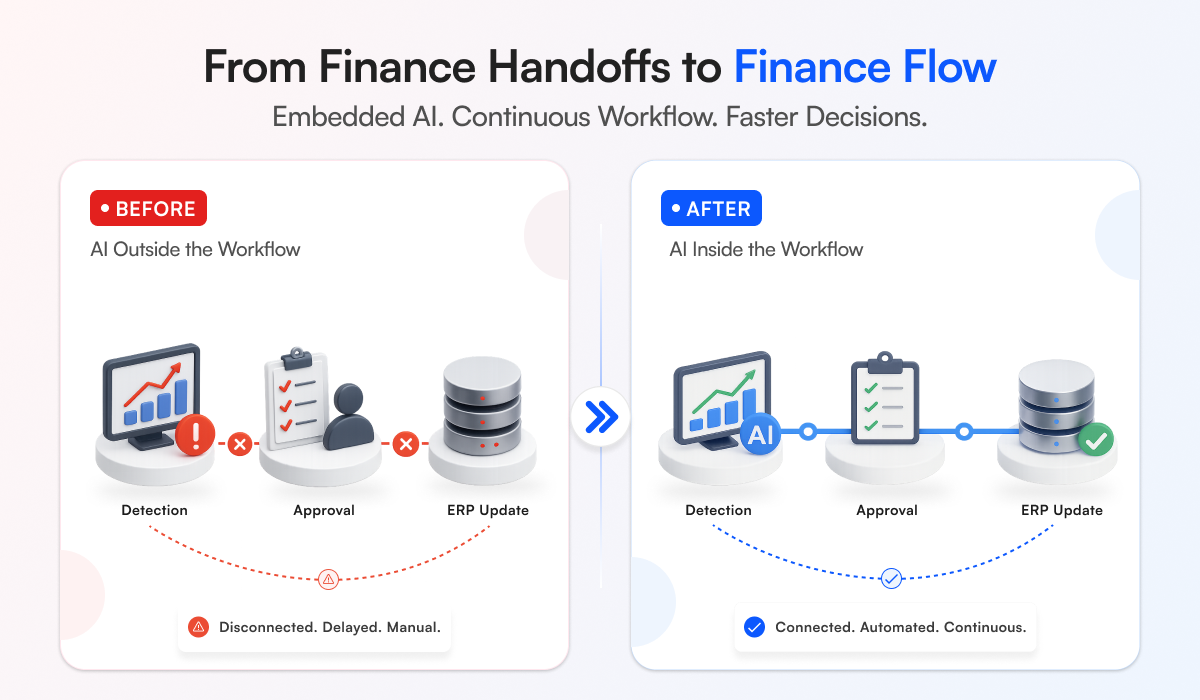
The shift that changes outcomes is not adding more AI. It is embedding AI directly into ERP-driven workflows, approval chains, and reconciliation systems where finance decisions actually move.
Finance teams increasingly see the difference when AI stops delivering outputs and starts moving decisions forward within the same operational flow, without breaking context or control.
When AI becomes part of the process, it doesn’t stop at generating an output. It continues the sequence with context intact. A reconciliation mismatch triggers a structured flow where related entries are pulled, rules are applied, and a draft explanation is prepared.
That output is automatically routed within the system to the responsible owner, reviewed in-context, approved, and recorded without breaking the system flow. For example, a mid‑cycle cash variance no longer gets flagged and parked. The workflow already knows the owner, the thresholds, the approvers, and the downstream system updates required.
The same approach also transforms financial close automation. Instead of waiting until the end of the period, AI prepares schedules, surfaces anomalies, and drafts commentary during the cycle itself.
Teams no longer spend time assembling information. They focus on reviewing and validating it.
The moment AI is inside the workflow, cycle time drops. This is where finance workflow automation becomes meaningful. It connects detection, interpretation, and action into a single, continuous flow.
AI Agents in Finance: Powerful, but Only Within Clear Boundaries
AI agents in finance are gaining attention because they can handle sequences instead of isolated tasks. In areas like reconciliation support, accounts payable exceptions, and close preparation, they can move work forward without waiting for manual triggers.
However, finance cannot operate on open-ended autonomy without governance controls. For agentic AI in finance to work, control must be designed into the system from the start.
A well-structured setup ensures:
- Access is limited to relevant financial and transactional data
- Actions follow defined rules and authority levels
- Approvals remain aligned with governance policies
- Every step is logged and traceable
When these boundaries are clear, AI agents become part of the workflow rather than a separate layer. They move tasks forward while preserving the control framework finance depends on.
Finance Is Moving from Processing Everything to Managing What Matters
The impact of AI in finance is more than doing the same work faster. It changes how work is distributed across the team.
A large portion of finance effort goes into matching, validation, reconciliation, and follow-ups. These activities are necessary, but they do not require continuous human involvement when systems are capable of handling them.
As AI takes over the first layer of processing, finance teams shift their focus. Instead of working through every transaction, they concentrate on exceptions, judgment, and decision-making. This leads to a more responsive operating rhythm where issues are identified earlier, decisions are made with better context, and the dependency on end-of-cycle corrections reduces.
The future of finance will not be fully automated. It is selectively human, where it matters most.
The Question Has Changed: It’s No Longer “Can AI Do This?”
Finance leaders are no longer evaluating whether AI can perform a task. That question has already been answered across multiple use cases.
The real question now is whether AI can be trusted to operate within finance workflows without disrupting control structures.
This is where decisions are being made:
- Can outputs be traced back to source data?
- Are decisions captured within the system of record?
- Do approval flows remain aligned with policy?
- Is the logic behind each result clear and explainable?
Organizations that address these questions move faster. They don’t treat governance as a separate layer; they build it into the workflow itself.
The Constraint Is No Longer the Technology
F&A AI has reached a stage where the technology is no longer the limiting factor. The constraint lies in how finance workflows are designed to absorb and act on intelligence.
When workflows remain fragmented, even strong AI struggles to deliver meaningful results. When workflows are connected, structured, and aligned with how finance operates, the same AI begins to create a notable impact.
The difference is not what AI can do. It is how far the workflow allows it to go.
CES works with finance teams to embed F&A AI directly into finance workflows, connecting ERP systems, reconciliation processes, approvals, and control frameworks. The focus is not on isolated automation, but on making finance workflow automation operate where decisions are executed, tracked, and governed.