
The $50 Invoice Nobody Talks About: Why Utility Bills Belong in Your Automation Strategy
For CFOs, the question isn’t whether a utility bill is worth automating. It’s whether finance should continue spending highly skilled people-hours processing something that technology can already handle.
Most finance leaders track automation ROI on the invoices that matter: large supplier contracts, complex three-way matches, high-dollar payment runs. Utility bills rarely make that list. The problem isn’t the value of each invoice. It’s the volume, repetition, and operational effort required to process them.
Why Utility Bill Processing Is Still So Manual
Walk through how most companies handle utility bills today, and it looks unchanged from a decade ago:
An analyst logs into a provider’s portal, finds the latest bill, downloads it, renames the file, and opens the ERP system. They key in the amount, the due date, and the account number. They repeat this for every location, every provider, and every billing cycle.
For a company with 50 locations across multiple utility providers, that’s not a once-a-month task. It’s a constant, low-grade drain on time that never shows up as a line item anywhere.
No single instance of this process looks expensive. That’s the trap. The cost is entirely in repetition.
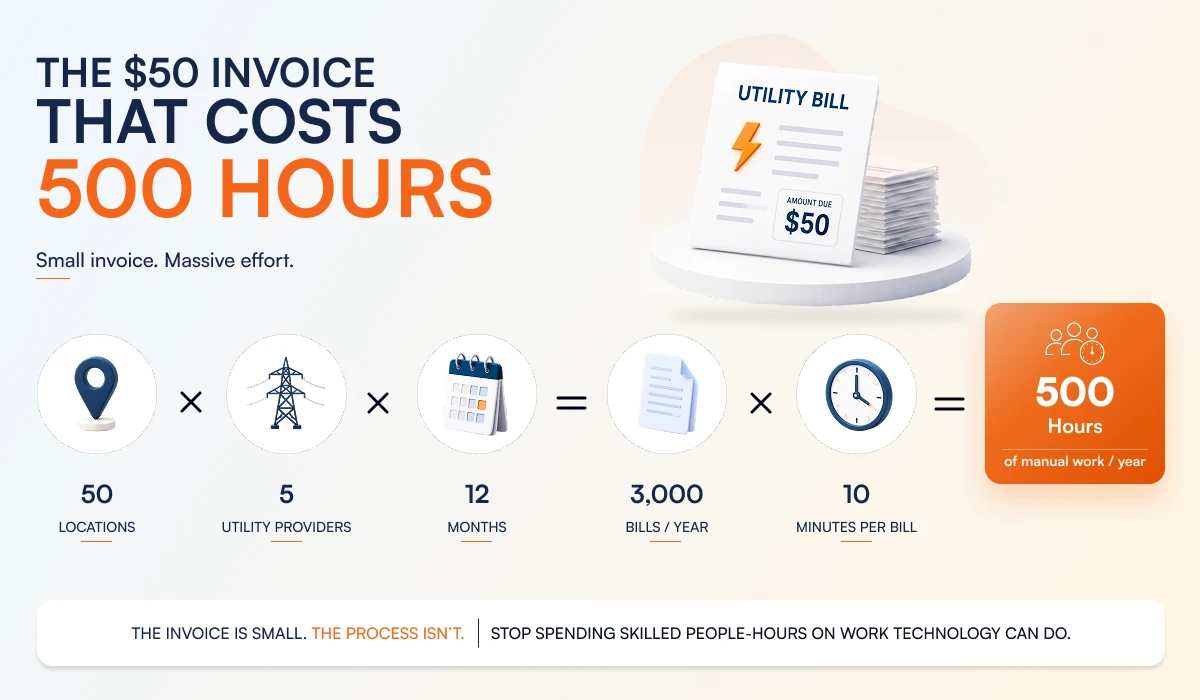
For example, 50 locations, five utility providers, and one bill per provider each month create 3,000 bills a year. At just 10 minutes of manual effort per bill, that’s roughly 500 hours of administrative work annually.
The invoice may be worth $50. The process around it isn’t.
The Hidden Cost of Manual Processing
Three things tend to go wrong when utility bill handling stays manual:
- Bills get missed. No one notices a provider didn’t send a statement until a late fee or disconnection notice arrives.
- Errors creep into the ERP. Manual entry means transposed numbers, wrong GL codes, occasional duplicate postings, all of which someone must catch and fix later.
- Visibility disappears. Without a live view of what’s outstanding, finance ends up reacting to utility costs instead of managing them.
None of these are catastrophic on their own. Together, over a year, across dozens of providers, they add up to a real – if quiet – cost.
What Intelligent Automation Actually Does
This isn’t a hypothetical capability. Automation platforms today can:
- Log into utility provider portals directly, without an employee initiating each session
- Support secure, provider-compliant authentication workflows, including MFA where supported
- Identify and extract the latest bill, pulling structured data – amount, due date, billing period – without manual entry
- Post that data straight into the ERP system, closing the loop without a human touching the file
- Track payment status, so retrieval and settlement are both visible in one place
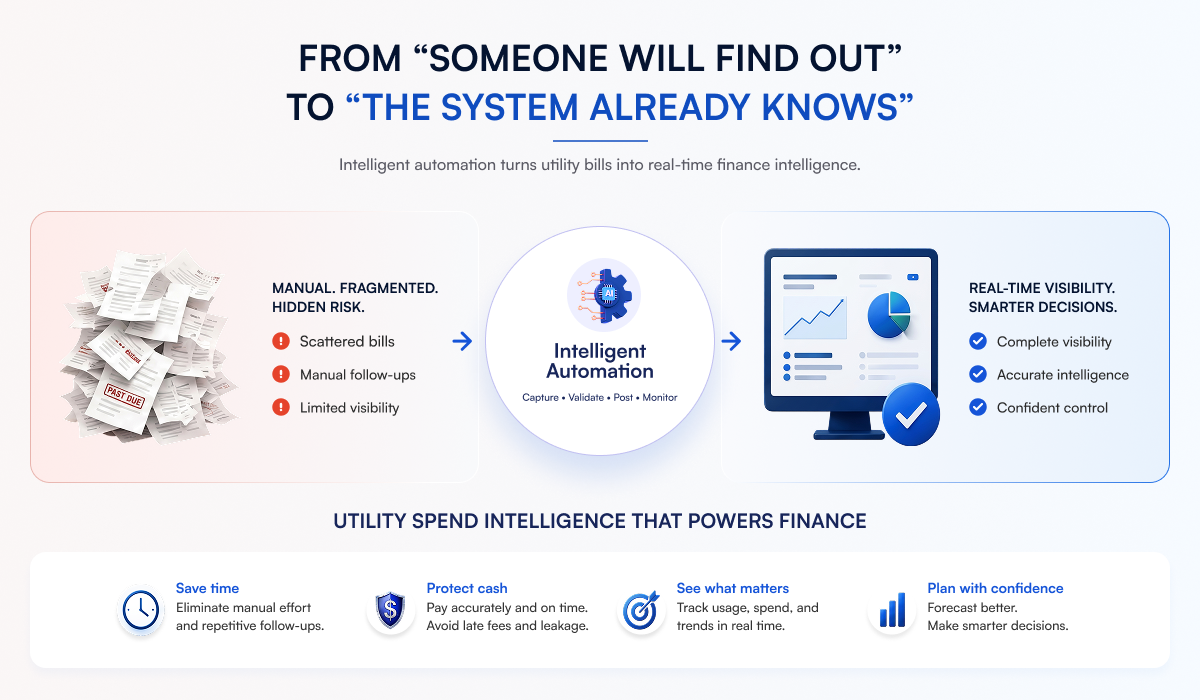
The result isn’t just faster processing; it’s a shift from “someone eventually finds out” to “the system already knows.”
Where AI Takes Automation Further
AI can add value beyond simply retrieving and entering bills:
- Recognizing different bill formats across providers
- Extracting and validating invoice information
- Detecting unusual changes in utility costs and identifying potential billing anomalies
- Identifying duplicate or potentially erroneous bills
- Predicting recurring utility expenses
- Highlighting exceptions that require human review
- Learning from prior billing patterns
The goal isn’t to eliminate people from the process. It’s to eliminate people from the predictable parts of the process, allowing finance teams to focus on exceptions, decisions, and analysis.
From Bill Automation to Utility Spend Intelligence
Automating the extraction is useful. What changes how finance operates is the visibility layer sitting above it – a live dashboard showing:
- Invoice status across every location and provider
- Bills that are missing or overdue, flagged automatically
- Outstanding payments and how long they’ve been outstanding
- Patterns – a provider consistently billing late, an unexplained cost spike, a portal that keeps failing
This is the part CFOs should care about most. It converts utility spend from something reconciled after the fact into something monitored in real time, giving finance better visibility into liabilities, cash requirements, anomalies, and trends while feeding directly into cash-flow forecasting and working-capital planning.
What Finance Leaders Gain
- Time back. Hours spent on portal logins and manual entry can go toward analysis and exception handling instead.
- No late fees. Missed payments and reconnection charges are avoidable costs once tracking is automatic.
- Cleaner data. Removing manual entry removes the most common source of AP errors.
- A better audit trail. Automated, logged processing tends to hold up better under audit than email threads and shared drives.
- Scale without added headcount. New locations or providers don’t require proportionally more AP staff.
- Real-time liability visibility. Knowing what’s owed today, not at month-end close.
The Challenges & How to Address Them
Automating this workflow isn’t friction-free. Here’s where things typically go wrong, and what tends to fix it:
| The Challenge | What Helps |
|---|---|
| Provider portals change | Continuous monitoring and rapid reconfiguration |
| MFA/security requirements | Secure, provider-compliant authentication |
| Different bill formats | AI-powered extraction and normalization |
| Credential security | Encrypted, access-controlled credential management |
| Failed or incomplete sessions | Exception-based monitoring |
| Employee resistance | Position automation as removing repetitive work |
These are solvable problems, but they require planning for iteration rather than expecting a single clean rollout.
Why Utility Bills Are a Smart Starting Point
Compared to more complex AP automation – three-way matching, dynamic discounting, complex approval workflows – utility bill extraction is a contained, low-risk place to build automation experience. It’s repetitive enough to show fast, measurable results, and simple enough not to require a major process overhaul first.
For finance leaders deciding where to invest automation resources next, this isn’t the flashiest use case. But it’s one of the clearest examples of manual effort producing very little strategic value – which makes it one of the easiest cases to justify.
For organizations building a broader intelligent finance strategy, utility bills can be a practical proof point – delivering measurable efficiency today while creating a foundation for greater automation, visibility, and predictive insight tomorrow.
The bigger question isn’t whether utility bill processing can be automated. It’s how much longer finance teams should keep doing it manually.
Connect with Ramesh Tavva to continue the conversation on AI in accounts payable and finance automation.