
How Poor AI Governance Can Impact Your Reputation
According to IBM, 77% organizations report they have adopted AI in at least one business function, yet fewer than one in three have a formal AI governance framework in place. A separate Gartner finding warns that through 2026, organizations without structured AI governance will face three times the rate of AI-related failures compared to those that govern responsibly. Adoption is accelerating. Governance is lagging. And the gap between the two is where reputations are lost.
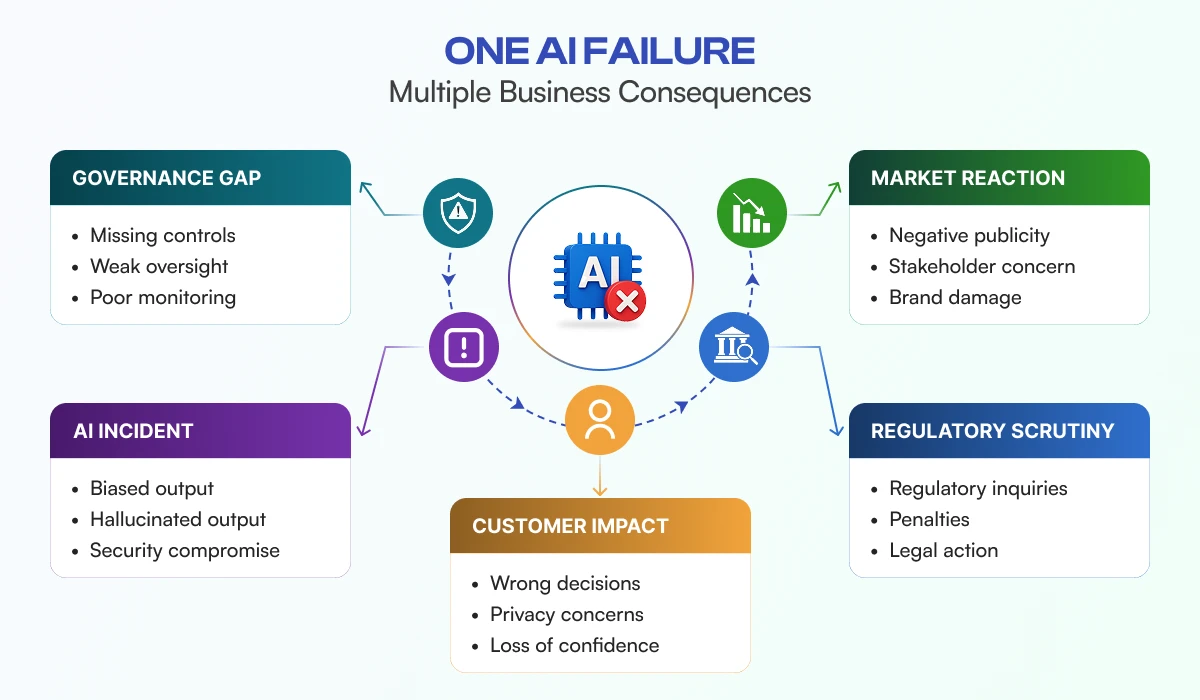
AI is no longer exclusive to large enterprises. Businesses of every size are building it into their core operations, and with that comes real exposure. Systems fail, outputs go wrong, and when they do, the consequences land on customers and companies both. Governance is what keeps those failures from becoming something much worse.
What is AI governance?
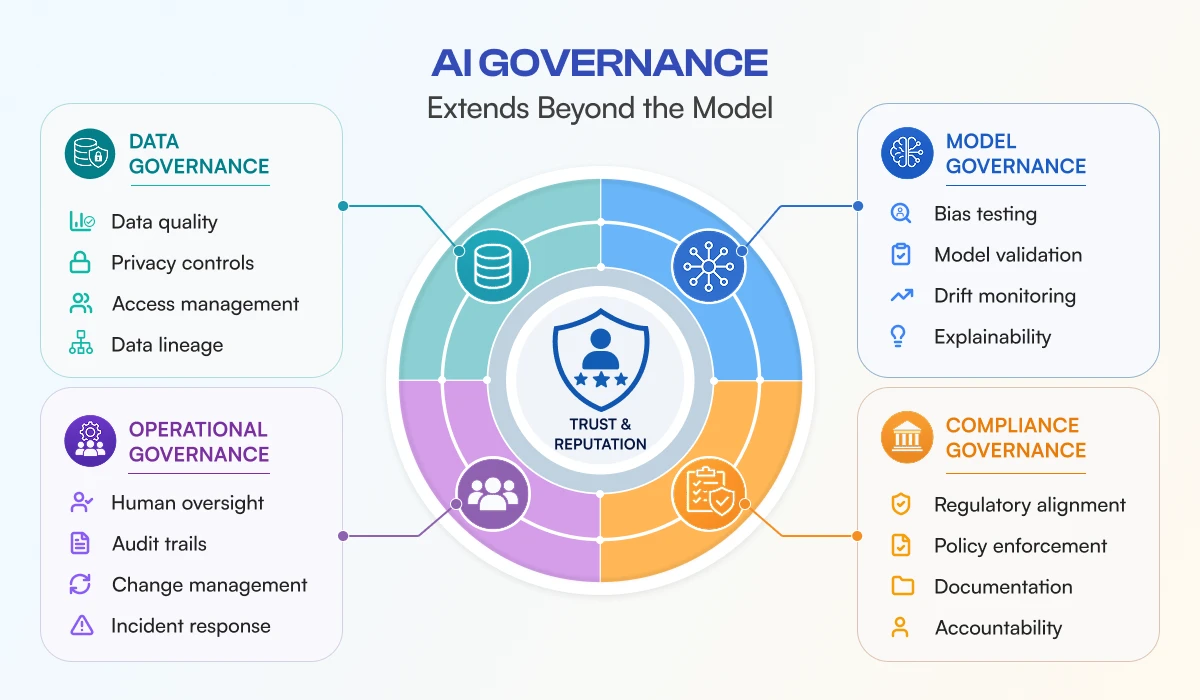
AI governance is how organizations make sure their AI systems do not operate unchecked. It covers the policies, practices, and frameworks that define responsible use, keep the business within legal and ethical boundaries, and protect the people the technology serves. Regulations change, models drift, and new risks emerge. Governance has to move with all of it, through continuous monitoring, regular audits, and updates that reflect both the evolving regulatory environment and the organization’s own standards. Get it right, and it becomes a genuine credibility signal in the market.
Data Privacy and Security
Trust takes years to build and can unravel in a single incident. AI systems now sit at the center of customer interactions, from conversational tools to data-heavy platforms, and they constantly handle sensitive personal information. When governance is weak, that data is at risk.
A privacy failure does not just expose customers. It signals to the market that the organization cannot be trusted with the data it collects. Stakeholders pull back. Regulators take notice. And when the breach happens, pointing fingers at an AI vendor does nothing to restore confidence. Clear policies, strong access controls, and accountability structures are what prevent these situations, not disclaimers after the fact.
AI and Biased Decisions
One of the most damaging outcomes of poor AI governance is AI bias. Just as human judgment can be biased, AI systems trained on flawed or unrepresentative data can produce prejudiced or unfair results at scale, and at speed.
Scenarios that illustrate how serious this gets:
- A healthcare platform that systematically underserves certain patient groups because the training data did not represent them fairly. People get worse care, and no one in the system flags it.
- A law enforcement tool that misidentifies individuals through facial recognition or skews predictive policing outcomes along demographic lines, with consequences that follow real people for years.
These are not hypothetical edge cases. When biased AI decisions become public, the organization behind the system bears the brunt of the damage. Recovery takes years, if it comes at all.
Data and System Poisoning
Conventional cybersecurity threats are well understood. AI introduces a different category of risk. Data poisoning happens when attackers corrupt training data before a model ever goes live, quietly shaping how it will behave in production. System-level vulnerabilities open a separate attack surface, where bad actors can access or manipulate AI outputs and the data behind them without touching a line of application code.
In early 2026, CodeWall, an independent security research firm, turned an autonomous AI agent loose on Lilli, McKinsey’s internal platform. It found SQL injection vulnerabilities across unauthenticated API endpoints. In under two hours, it had read and write access to 46.5 million chat messages, 728,000 files, and the system prompts shaping how Lilli responded to McKinsey’s consultants.
The vulnerability was patched within hours and no client data was confirmed accessed by unauthorized parties. But the story went out. An organization synonymous with rigorous thinking had left basic infrastructure exposed.
No organization is too sophisticated to be hit. When AI outputs get compromised and customers feel the effects, confidence in the system does not come back easily.
Unpredictable “Hallucinations” and Errors
AI hallucinations have become a serious problem for enterprises. An AI hallucination occurs when a Large Language Model (LLM) confidently produces false or entirely fabricated outputs, presented with the same certainty as accurate information.
These hallucinations appear across sectors:
- Legal research AI might generate citations to cases that do not exist.
- Medical AI could reference studies that are entirely fabricated.
- Financial AI may issue recommendations based on invented market data.
Customers who act on this information get hurt. And the organization that put that AI in front of them owns the consequences, both legally and reputationally.
Regulatory Non-Compliance
Various countries have introduced regulations related to AI governance. The EU AI Act and the U.S. AI Executive Order have been issued to ensure safe and responsible use of AI. Organizations must be aware of these requirements and continuously update their AI systems to maintain compliance.
Failing to do so can result in hefty fines and lawsuits.
- iTutor Group was fined $365,000 after its AI recruiting tool rejected applicants based on age and gender.
- Air Canada was ordered to pay damages after its AI assistant gave customers wrong information about bereavement fares.
- Clearview AI was fined €20 million each in France and Italy, and €34 million in the Netherlands, for collecting facial images without consent.
Fines can be absorbed. The public label of an organization that ignored its obligations to protect people is much harder to shake.
Establishing AI Governance
Every scenario in this blog, bias, poisoning, hallucinations, regulatory failures, comes back to one thing: a governance gap that should not have existed. None of these outcomes were inevitable. They were preventable.
Managing AI governance in-house while running operations is a real challenge. The scope covers policy design, risk frameworks, data controls, model behavior, regulatory alignment, and continuous monitoring. Most organizations do not have the bandwidth to do it well without support. That is why dedicated AI governance consulting has become a serious business decision, not just a compliance exercise.
The right partner does not show up with a ready-made framework and ask you to fit into it. They look at how your organization runs: where your data lives, what regulatory exposure you carry, how your models behave in production, where the security boundaries sit. From that, they build governance that works in practice, not just on paper, and they take the operational weight off internal teams in the process.
CES approaches AI governance exactly this way. We work from real-world constraints, not templates. We define policy, standards, controls, and decision paths aligned to your organization, and we help you govern the full cycle from risk assessment to ongoing monitoring. The result is a governance structure that protects your operations, your customers, and your reputation, built to hold up as AI evolves.