
Healthcare Interoperability in 2026: Beyond HL7 FHIR to Intelligent Health Data Exchange
How Healthcare Organizations Can Move Beyond Compliance to Clinical and Financial Transformation
Healthcare interoperability has reached a turning point. National frameworks such as TEFCA, widespread HL7 FHIR adoption, and significant investments in Electronic Health Record (EHR) integration have laid the foundation for connected healthcare. Yet many healthcare organizations continue to face fragmented workflows, disconnected clinical systems, and rising operational costs.
In 2026, clinicians still switch between multiple applications, care teams struggle with inconsistent patient data, and healthcare executives oversee dozens of disconnected systems without realizing the expected improvements in patient outcomes, operational efficiency, or financial performance.
The challenge isn’t the lack of standards. The challenge is that many hospitals and health systems still depend on decades-old interoperability infrastructure built around HL7 v2 interfaces, custom point-to-point integrations, and siloed architectures. While national interoperability mandates continue to evolve, replacing legacy integration remains one of healthcare’s biggest modernization challenges.
This is where Intelligent Health Data Exchange (IDX) creates measurable business value.
Why HL7 FHIR Adoption Alone Isn’t Enough?
HL7 FHIR (Fast Healthcare Interoperability Resources) has transformed healthcare data exchange by introducing standardized APIs, modern data models, and faster system connectivity. However, simply implementing FHIR APIs does not guarantee true healthcare interoperability.
The real challenge lies in semantic interoperability, ensuring that clinical information maintains the same meaning across EHR platforms, payer systems, laboratories, pharmacies, and healthcare applications.
For example, healthcare organizations commonly exchange data across platforms such as:
- Epic
- Oracle Health (formerly Cerner)
- MEDITECH
- Athenahealth
- Payer platforms
- Health Information Exchanges (HIEs)
Each ecosystem often uses different coding structures, workflows, and clinical terminologies.
Achieving meaningful interoperability requires FHIR ConceptMap resources combined with standardized clinical vocabularies such as:
- SNOMED CT
- LOINC
- RxNorm
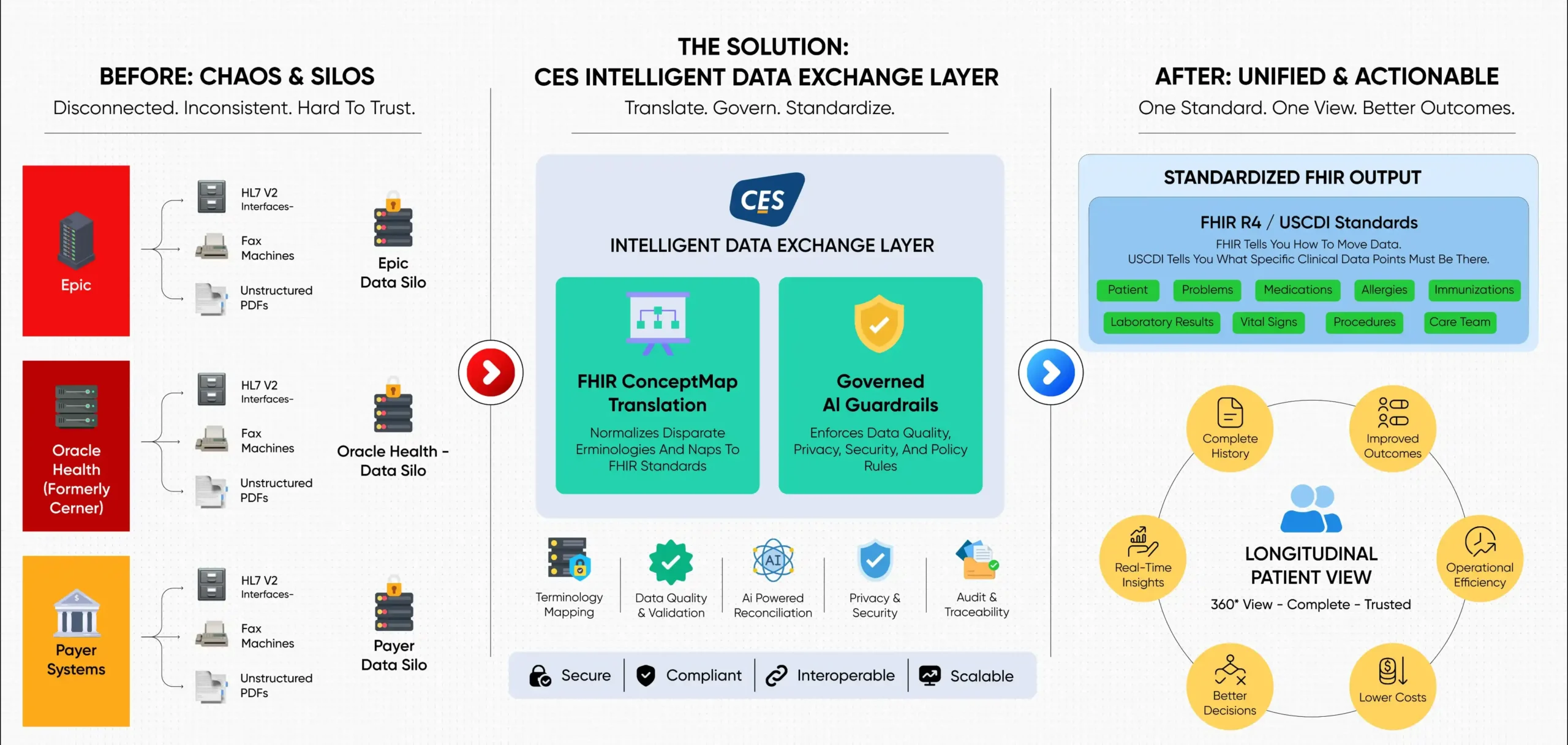
Without semantic alignment, organizations continue to rely on manual mapping, duplicate interfaces, and expensive maintenance. Industry estimates suggest that fragmented interoperability contributes to nearly $30 billion annually in avoidable inefficiencies across healthcare.
What Is Intelligent Health Data Exchange?
Intelligent Health Data Exchange (IDX) extends traditional FHIR interoperability by adding a governed intelligence layer that improves data quality, automation, and clinical usability while maintaining strict compliance with healthcare regulations.
Rather than replacing FHIR, Intelligent Data Exchange enhances it through several core capabilities.
Semantic Normalization
AI-assisted mapping using FHIR ConceptMap helps standardize clinical terminology across different healthcare systems. This significantly reduces the manual effort required to reconcile coding differences while lowering the long-term maintenance burden associated with traditional point-to-point integrations.
Intelligent Processing of Unstructured Data
Healthcare organizations still manage enormous volumes of unstructured information, including PDFs, scanned records, physician notes, referral documents, and discharge summaries.
AI-assisted mapping suggests structured FHIR resources while governed validation workflows maintain compliance, transparency, and complete auditability.
Contextual Clinical Enrichment
Modern interoperability goes beyond moving data between systems.
Intelligent platforms automatically enrich incoming information with:
- Social Determinants of Health (SDOH)
- Patient risk scores
- Care gaps
- Clinical context
This enables providers to make more informed decisions without requiring additional manual review.
Real-Time Prior Authorization Using FHIR Subscriptions
FHIR Subscriptions enable real-time server-driven notifications instead of traditional polling or manual workflows.
This modern approach supports faster prior authorization processing while aligning with evolving CMS interoperability mandates and reducing administrative delays.
TEFCA and FHIR Working Together
Rather than centralizing healthcare data, TEFCA combined with FHIR enables secure nationwide data exchange while allowing organizations to retain control of their information.
This architecture supports scalable interoperability across providers, payers, and digital health ecosystems.
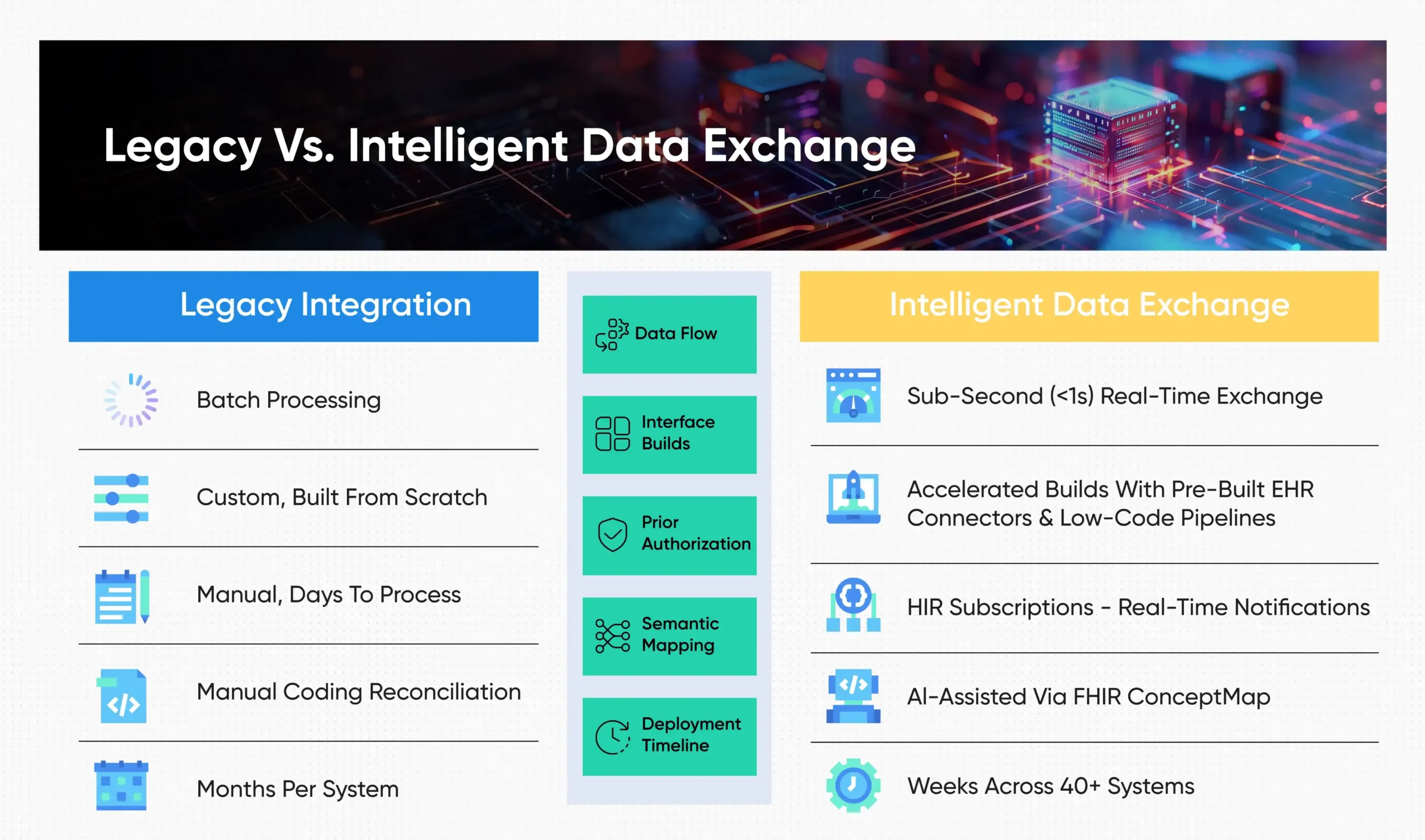
At a Glance: Legacy vs. Intelligent Data Exchange
How CES Enables Intelligent Healthcare Interoperability
CES transforms the Intelligent Data Exchange model into a scalable, production-ready interoperability platform.
Our FHIR-native integration capabilities provide secure, HIPAA-compliant connectivity across Epic, Oracle Health, and more than 40 healthcare systems, enabling real-time interoperability for health systems, payers, and healthcare technology companies.
For Health Systems and Providers
Healthcare providers benefit from faster deployment and simplified integration through:
- Accelerated interface development using pre-built EHR connectors and low-code integration pipelines
- Sub-second (<1 second) real-time healthcare data exchange instead of traditional batch processing
- Consistent, high-quality interoperability across more than 40 clinical systems
- Reduced dependence on custom interface development and legacy integration maintenance
For Health Insurance Payers
CES helps payers streamline administrative workflows by enabling:
- FHIR Subscription-based prior authorization, reducing approval timelines from days to seconds
- Lower administrative overhead through automated interoperability
- CMS-0057-F compliant APIs that simplify access to clinical information without manual provider follow-up
For Healthcare Technology Companies
Digital health platforms and healthcare startups can accelerate growth by:
- Going live across more than 40 healthcare systems within weeks rather than months
- Eliminating the need to build custom EHR integrations
- Focusing engineering resources on innovation while CES manages interoperability infrastructure
Across these scenarios, CES helps organizations reduce integration timelines from months to weeks while maintaining:
- HIPAA compliance
- SOC 2 Type II certified security
- HITRUST framework readiness
- Enterprise-grade healthcare data protection
Why Healthcare Interoperability Is Becoming a Strategic Business Advantage
Healthcare interoperability has evolved beyond regulatory compliance.
Today, connected health data directly supports:
- Value-based care initiatives
- Population health management
- AI-powered clinical decision support
- Faster mergers and acquisitions
- Improved patient experiences
- Operational efficiency
- Financial performance
- Enterprise analytics
Organizations that continue relying on legacy integration architectures risk slower innovation, higher operational costs, and reduced competitiveness.
Modern healthcare leaders recognize that intelligent interoperability creates the foundation for scalable digital transformation.
Future-Proof Your Healthcare Interoperability Strategy with CES
The healthcare industry has already established the standards. The next competitive advantage comes from implementing them intelligently.
By combining HL7 FHIR, TEFCA, AI-assisted semantic interoperability, and secure healthcare integration, organizations can move beyond compliance and unlock measurable clinical, operational, and financial outcomes.
Ready to modernize your healthcare interoperability strategy? Let’s build smarter, FHIR-native data exchange.
Partner with CES to build intelligent, FHIR-native healthcare data exchange that accelerates innovation, improves patient care, and prepares your organization for the future of connected healthcare.
Author – Neha Tyagi (Lead Software Interoperability Engineer)
Co-author – Sowndarya Sathishkumar