
Data + AI: Why AI Readiness is a Data Foundation Question First
Every executive wants the competitive edge of generative AI. We all want the “magic” of asking a Copilot complex questions and getting instant, strategic answers. But as data architects, we see a recurring pattern: organizations buy the AI licenses, turn them on, and are immediately confronted with hallucinations, missing context, or worse—security liabilities.
The hard truth is that AI is not a plug-and-play software upgrade. It is an amplifier. If your data is well-architected, AI amplifies your intelligence. If your data is siloed, messy, or poorly governed, AI will simply scale the chaos.
To get enterprise AI right, you have to get data engineering right first. Here is why true AI readiness is fundamentally a data foundation challenge.
1. You cannot build an AI skyscraper on a data swamp
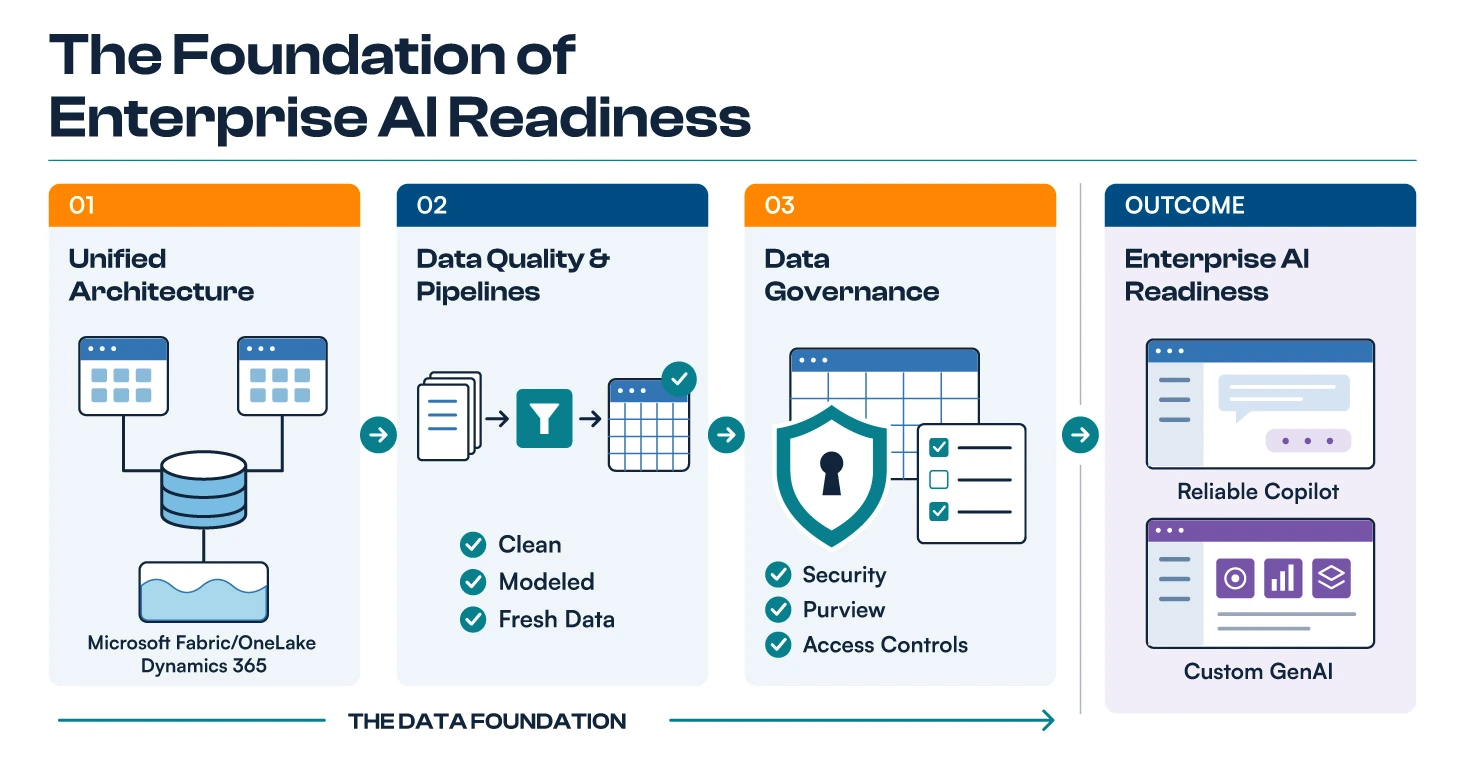
Generative AI requires deep context to be useful. If your ERP data in Microsoft Dynamics 365 is disconnected from your operational databases and your CRM, your AI is flying blind. A Copilot can only reason over the data it can see.
The solution isn’t more algorithms; it’s better architecture. Transitioning to a unified data architecture—like Microsoft Fabric’s OneLake—creates a single, logical source of truth. By breaking down silos and consolidating your data estate, you give your AI the comprehensive context it needs to provide accurate, business-critical insights rather than fragmented guesses.
2. The inconvenient truth of data pipelines
The old adage “garbage in, garbage out” has evolved. In the age of LLMs, it’s now “garbage in, catastrophic automated decision out.”
Before a model can generate a strategic summary, a data engineer must ensure the underlying data is clean, modeled, and fresh. This requires robust ETL/ELT pipelines. High-quality AI is built on the unglamorous, vital work of data engineering. If your pipelines are brittle, your AI’s outputs will be untrustworthy. A modern data foundation automates and secures these pipelines, ensuring the fuel for your AI engine is always premium grade.
3. Governance is a prerequisite, not an afterthought
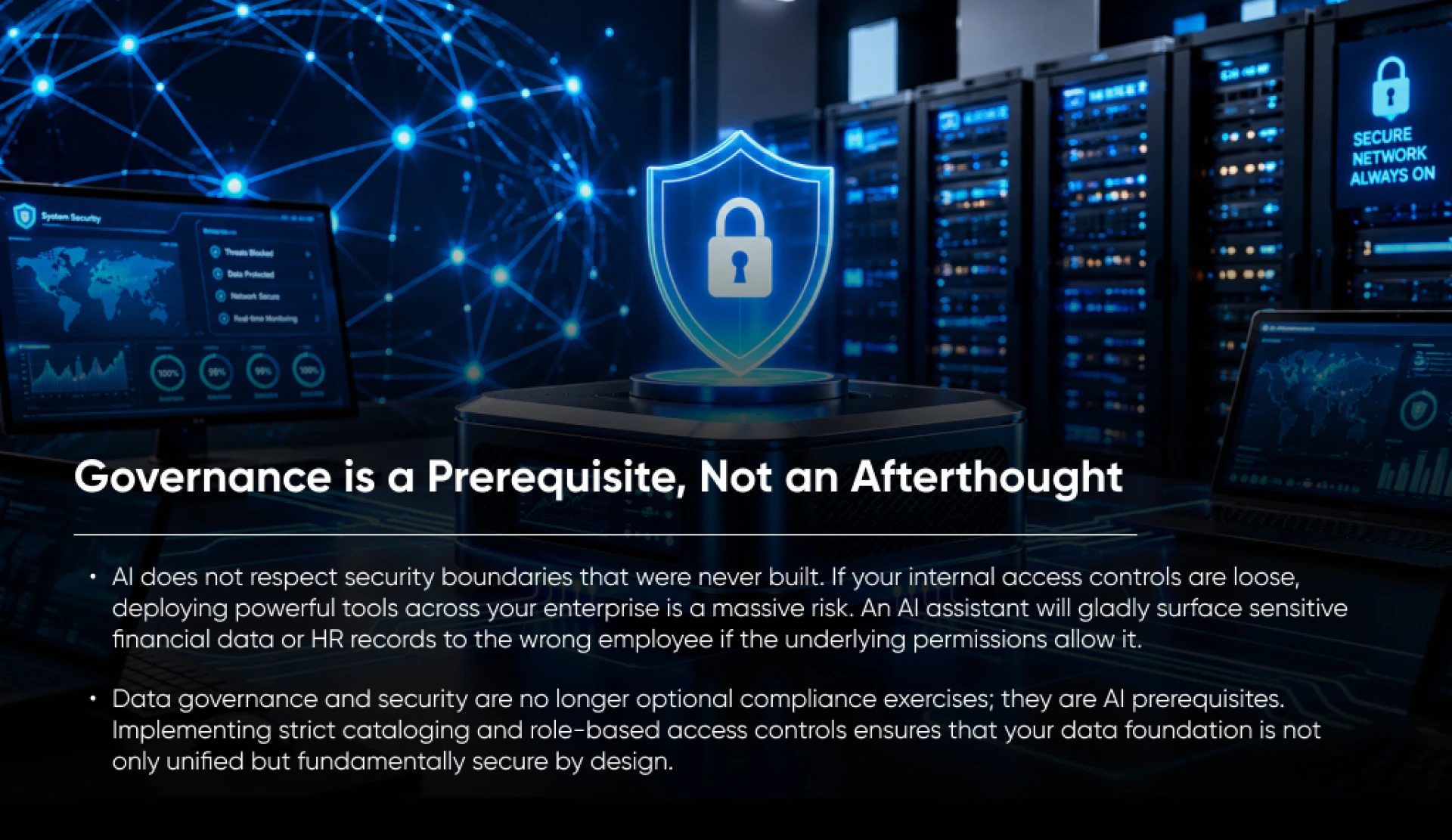
AI does not respect security boundaries that were never built. If your internal access controls are loose, deploying powerful tools across your enterprise is a massive risk. An AI assistant will gladly surface sensitive financial data or HR records to the wrong employee if the underlying permissions allow it.
Data governance and security are no longer optional compliance exercises; they are AI prerequisites. Implementing strict cataloging and role-based access controls ensures that your data foundation is not only unified but fundamentally secure by design.
AI readiness is an ongoing journey of modernizing your data foundation. It requires moving from legacy silos to unified cloud architectures like Microsoft Fabric, integrating deep context from platforms like Dynamics 365, and enforcing strict governance.

About the Author
Priyanka Nijhawan is a data architect and technology leader with 15 years of experience building modern data platforms on Azure and AWS. She specializes in data strategy, governance, and enterprise-scale engineering solutions that help organizations unlock the value of data and prepare for AI-driven transformation.