
Common Area Maintenance (CAM) Reconciliation From Year-End Scramble to Strategic Advantage
Every dollar of recoverable CAM expense that goes unbilled is a dollar of Net Operating Income (NOI) left on the table. At a 6% cap rate assumption, failing to recover just $60,000 a year erases about $1 million in property value. Late statements can turn valid receivables into write-offs, and thin backup turns routine tenant questions into costly audits.
Yet many portfolios still run CAM on spreadsheets, scanned leases, and one person who knows how the workbook works. Understanding where CAM reconciliation breaks down is the first step toward improving recovery, strengthening controls, and transforming an annual accounting exercise into a more predictable, technology-enabled process.
First, the mechanics.
Understanding the fundamentals
CAM reconciliation is the annual true-up between the estimates tenants paid and what their leases say they owe. CAM covers shared-space costs: landscaping, snow removal, parking lots, security, common-area utilities, and repairs. Under most commercial leases, especially net leases, tenants reimburse their share.
Because actual costs aren’t known until the year closes, the process runs as a cycle. Tenants prepay monthly estimates; after year-end, the landlord bills any shortfall or credits any overpayment and resets next year’s estimates.
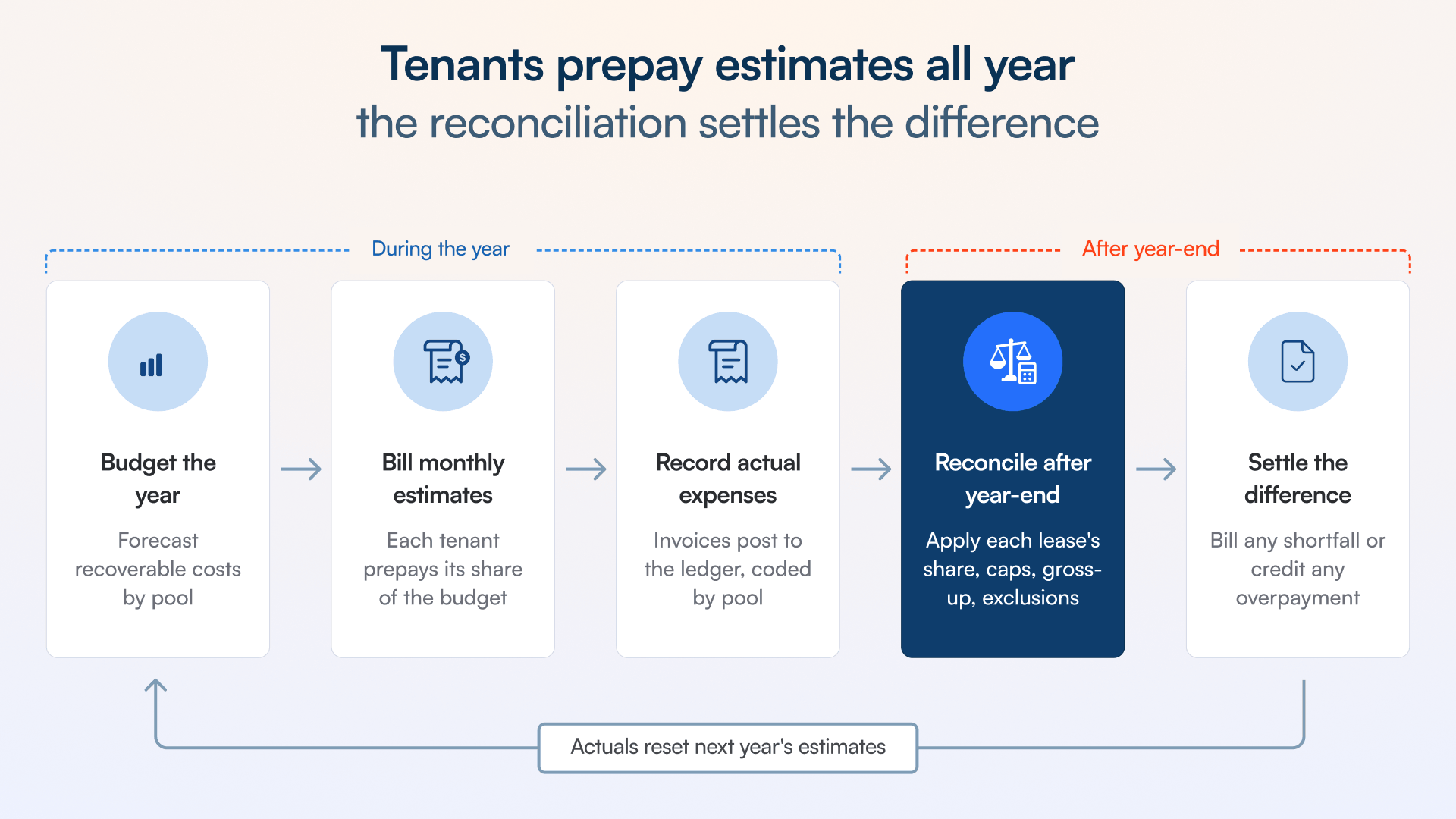
CAM reconciliation cycle · 5 steps, repeating each year.
Only the last two steps happen after year-end, which is why the reconciliation collides with the close.
The formula itself is simple:
Balance due = Recoverable expenses x Tenant’s share – Estimates paid
A negative balance becomes a credit. The catch is that the lease, not the accountant, defines every input. These terms move the number most:
| Lease term | What it controls |
|---|---|
| Pro-rata share basis | The denominator: leasable, leased, or occupied area, sometimes with a floor |
| Gross-up | Adjusts variable costs to a stated occupancy, often 95% or 100% |
| Base year or expense stop | Tenant pays only increases above a reference year or amount |
| Caps | Limit yearly growth in controllable costs; cumulative and compounding caps differ |
| Exclusions | Costs a tenant never pays, such as capital items or leasing commissions |
| Admin fee | A percentage markup on CAM, often with its own carve-outs |
| Anchor contributions | Fixed payments from major tenants that shift the math for everyone else |
| Separate pools | Taxes, insurance, or a parking deck, each shared on its own basis |
One definition can swing the bill by thousands. Take a 5,000-square-foot tenant in a 100,000-square-foot center that is 80% occupied, with $840,000 of recoverable CAM and $38,000 already paid in estimates.
| Pro-rata share basis | Denominator (sq ft) | Tenant’s share | Tenant’s CAM for the year | Balance after $38,000 in estimates |
|---|---|---|---|---|
| Total leasable area | 100,000 | 5.00% | $42,000 | $4,000 due |
| Occupied area (center 80% occupied) | 80,000 | 6.25% | $52,500 | $14,500 due |
Same building, same costs: a $10,500 swing from one definition. That is why tenants negotiate these terms hard, and why accountants must apply them exactly as written.
On paper, it’s a formula. In practice, it tests lease data, expense data, deadlines, and relationships all at once, and that’s where it breaks.
Seven common CAM challenges – and how to address them
Seven problems cause most CAM pain, and each has a practical fix. Left alone, each one makes the others worse.
Every lease writes its own rules
Recovery terms hide across hundreds of leases, amendments, and side letters. Miss a cap granted at renewal or a suite’s new square footage, and you over-bill and invite a dispute, or under-bill and lose income.
The fix starts upstream, with a structured lease abstract for every tenant. It should capture every recovery term, from share basis and caps to audit rights and statement deadlines. Update it at every lease event, and have a second reviewer check it against the source.
Bad coding poisons the pool
Perfect lease data can’t rescue bad expense data. Invoices land in the wrong property, capital projects sit in operating accounts, and leasing commissions slip into recoverable pools. Found at year-end, each error costs days of rework.
Build recoverability into the chart of accounts, so every operating account maps to a pool or carries a non-recoverable flag. Enforce coding when invoices are entered, and review recoverable accounts monthly, not annually.
One workbook, one person, one point of failure
Spreadsheets are flexible, which is exactly what makes them risky at scale. Workbooks fill with hard-coded overrides, broken links, and formulas only their author understands. When that person leaves, the method leaves too.
In the short term, lock a standard template, document each property’s special terms, and require independent review. Long term, move the calculation into a system that applies lease rules the same way every time.
Deadlines that turn receivables into write-offs
CAM reconciliation lands on top of the year-end close, audits, tax filings, and budgets. Many leases require statements within a set window, often 90 to 180 days after year-end. Some limit or waive the landlord’s right to collect if the statement is late.
Stop treating CAM as a once-a-year event. Run quarterly pre-reconciliations with the same logic as the final true-up, and track each lease’s deadline individually so the most urgent statements go first.
Moving parts multiply the math
Vacancies, move-ins, move-outs, expansions, and remeasurements all shift the denominator, and each shift interacts with caps and gross-ups. A capped, grossed-up share for a tenant who expanded in July is easy to get wrong, and tenant auditors know it.
Rules-based logic that prorates the same way every time is the lasting fix. Until then, keep test cases for the trickiest scenarios and rerun them before every cycle.
Stale estimates create surprise bills
When estimates rest on a stale budget, the true-up becomes a shock. Big catch-up bills strain tenant relationships and slow collection, while big refunds mean the landlord held tenants’ cash all year.
Reforecast CAM at mid-year and adjust estimates when actuals drift. Track estimate accuracy by property, and feed the variance back into next year’s budget.
Weak backup invites disputes
Tenants scrutinize CAM closely, and many leases grant audit rights for a set period after the statement arrives. Some shift the audit cost to the landlord if overcharges pass a threshold, often 3% to 5%. Without clear backup, even accurate charges get disputed, and teams concede amounts just to close the file.
Transparency is the best defense. Show the pool, the share calculation, applied caps and exclusions, and a prior-year comparison on every statement. Keep invoice-level support filed by pool, and call tenants before a big increase lands.
Fix these, and you stop the leaks. The bigger prize is what a clean reconciliation tells you.
Beyond Reconciliation: Turning CAM data into business intelligence
A clean reconciliation shows how efficiently each property runs, where income leaks, and which lease terms help or hurt.
Start with the recovery ratio: the share of recoverable operating expenses actually billed back to tenants. When comparable properties diverge, the gap points to vacancy, generous caps, outdated anchor contributions, or coding errors. Because value tracks NOI, every point of leakage shows up in valuation, not just the P&L.
The same data sharpens every team that touches the property. Property managers spot cost-per-square-foot outliers, vendors whose costs are climbing fastest, and repeat repairs that signal a capital replacement. Asset managers see true NOI and the drag from vacancy and concessions.
Leasing teams learn what each negotiated term really costs, such as how much an old cap absorbs every year. FP&A gets a feedback loop for budgets, and tenant-facing teams field fewer disputes. Property accountants, freed from chasing numbers, finally get to analyze them.
Producing that insight by hand across a portfolio doesn’t scale. Automation does.
Automation: From manual reconciliation to intelligent automation
Automation doesn’t replace judgment; it removes the rekeying and rework that crowd judgment out. Lease data, ledger data, and calculation logic connect, so each step feeds the next.
The opportunity extends beyond automating calculations. An integrated CAM reconciliation platform can create a single source of truth across lease agreements, property expenses, tenant allocations, and recovery statements. Finance teams gain visibility into recovery performance throughout the year, while standardized workflows reduce dependency on spreadsheets, manual intervention, and individual knowledge. The result is a more scalable operating model that supports portfolio growth without proportionately increasing accounting resources.
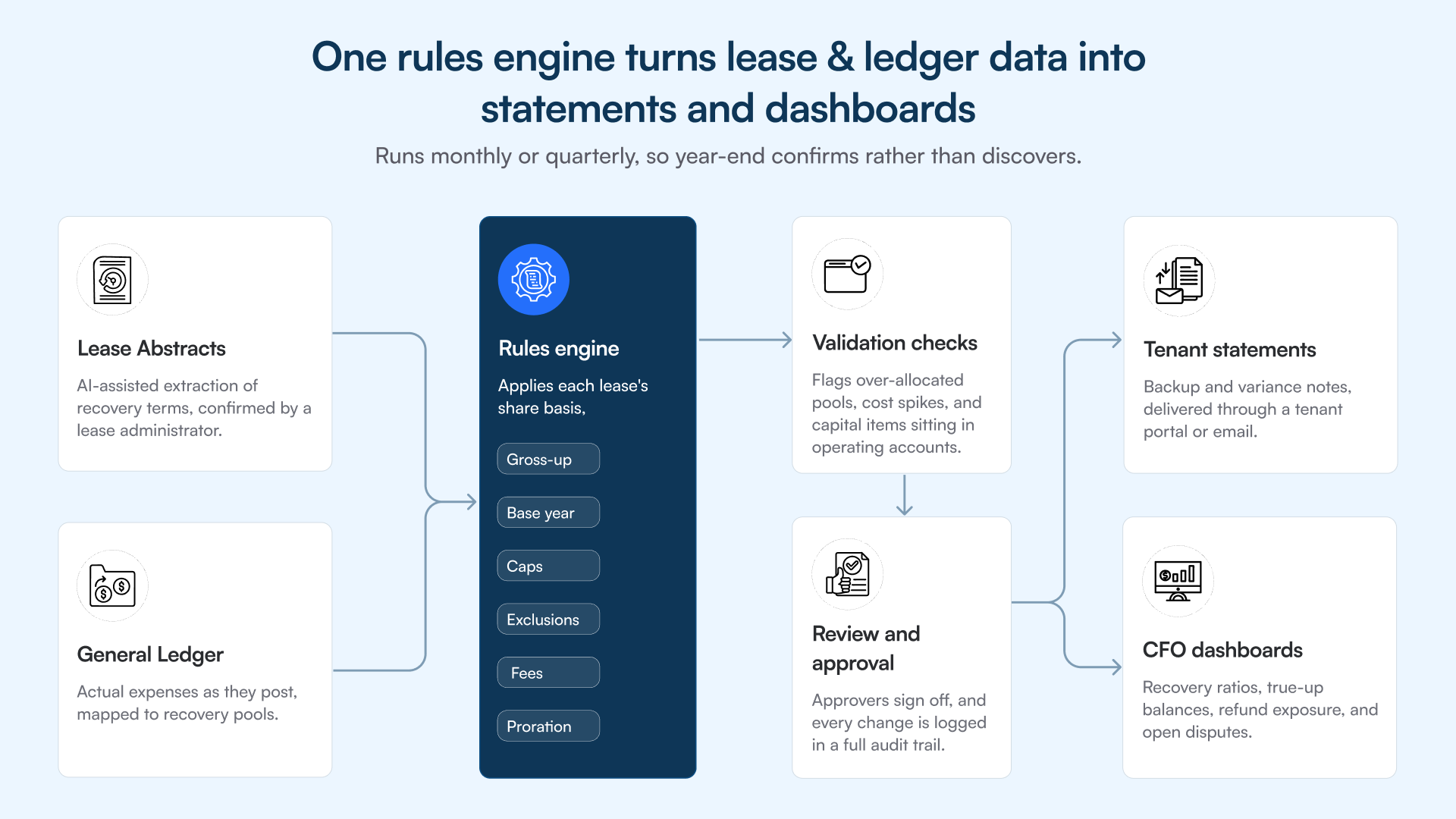
automated CAM reconciliation flow · 2 inputs, 3 steps, 2 outputs
People stay in the loop where judgment matters: confirming lease terms and approving results before anything reaches a tenant.
AI-assisted abstraction pulls recovery clauses from leases and amendments, and a lease administrator confirms each term before it goes live. Ledger integration brings in actual expenses as they post, already mapped to pools.
A rules engine applies every lease term the same way, every time. Validation checks catch what tenants would otherwise find: over-allocated pools, cost spikes, and capital items in operating accounts. Statements go out with backup and variance notes, and an audit trail records every change.
The real shift is timing. When the calculation runs monthly or quarterly, year-end becomes a confirmation, not a discovery. Nowhere is that felt more than in the CFO’s office.
The CFO Advantage: Better recovery, stronger controls, greater visibility
Reconciliation cycles that once took months can shrink to weeks. Recovery ratios, true-up balances, refund exposure, and open disputes become visible by property, on demand. And the payoff reaches all three financial statements.
| Value lever | What changes | Where it shows up |
|---|---|---|
| Fewer missed recoveries | Every lease term applied, every recoverable cost billed | Recovery revenue, NOI, and property value |
| Faster statements | True-up invoices go out sooner | Cash flow and receivables |
| Fewer disputes | Clear backup answers questions before they escalate | Concessions and write-offs |
| Accurate accruals | Year-end true-ups calculated, not estimated | Close speed and post-close adjustments |
| Audit-ready records | Every calculation documented and traceable | External and tenant audit effort |
| Scalable capacity | New properties absorbed without matching headcount | Accounting cost per property |
Automation also lets CFOs look ahead. The same engine can model a pricier security contract, showing which tenants hit their caps and how much the landlord absorbs.
Technology works best on a clean foundation. These habits make every cycle stronger, automated or not.
CFO Scorecard: Building a stronger CAM control framework
The strongest CAM programs share a few habits. Keep the lease abstract as the single source of truth, updated at every amendment, remeasurement, or renewal. Run pre-reconciliations quarterly, against a calendar of each lease’s statement deadline and audit window.
Make every pool tie out: amounts billed to tenants plus what the landlord absorbs for vacancy, caps, and exclusions must equal total pool expenses. This one control catches a surprising number of errors, especially with an independent review before statements go out.
Explain big year-over-year changes in plain language on every statement. After each cycle, log tenant inquiries by root cause and feed the lessons into next year’s abstracts, coding, and estimates.
On the accounting side, book the year-end true-up accrual from the best available calculation, not last year’s run rate. Confirm the presentation of CAM recoveries with your auditors. Under ASC 842, it depends partly on whether you elected to combine lease and non-lease components; IFRS 16 differs.
Finally, measure it. These seven numbers tell a CFO whether CAM is protecting income or leaking it, each with a question worth asking your team.
| Metric | What it reveals | Ask your team |
|---|---|---|
| Recovery ratio by property | How much recoverable expense actually reaches tenants | Which properties recover the least, and why? |
| Reconciliation cycle time | Days from year-end to statements issued | When will the last statement go out? |
| On-time delivery rate | Share of statements sent before each lease’s deadline | Has a late statement ever cost us a recovery? |
| Dispute rate and concessions | How often charges are challenged, and what settling costs | What did we concede last year, and why? |
| Estimate variance | Gap between estimates billed and actual charges | Which tenants face the biggest true-up surprise? |
| Days to collect true-ups | How fast reconciliation billings turn into cash | How much true-up cash is still outstanding? |
| Time to produce backup | How quickly a tenant’s full support can be assembled | Could we defend any tenant’s charges within a day? |
If those questions are hard to answer, that is the clearest sign of where to start.
Making CAM reconciliation work at portfolio scale
For real estate organizations managing multiple properties, CAM reconciliation requires more than accounting expertise. It requires standardized processes, accurate lease data, disciplined expense management, and technology that can scale across the portfolio.
A combination of experienced property accounting professionals, structured delivery models, and intelligent automation can help organizations improve recovery accuracy, accelerate reconciliation cycles, strengthen audit readiness, and optimize accounting costs.
The objective is not simply to complete reconciliations faster. It is to build a repeatable, transparent, and scalable process that protects property income and provides finance leaders with actionable insights.
The bottom line: From CAM compliance to financial performance
CAM reconciliation rarely makes the board deck, but it touches revenue, cash, valuation, and audit risk at once. Run in spreadsheets, it leaks money quietly. Run as a continuous, automated control, it brings cash back sooner, protects NOI, and gives finance numbers it can defend.
Start small. Baseline your recovery ratio this quarter, clean the lease abstracts and account mapping for one property, and run its first pre-reconciliation before year-end. Then let the results make the case for the rest.
Protecting NOI does not always require generating more revenue. Sometimes, it starts with recovering what you are already entitled to.
Is your CAM reconciliation process delivering its full potential?
Whether you are looking to improve recovery accuracy, accelerate reconciliation cycles, strengthen financial controls, or explore intelligent automation, CES can help you build a more efficient and scalable property accounting operation.
Let’s start a conversation about making your CAM reconciliation process work smarter.
The money has already been spent. Make sure it comes back.

About the Author
Ramesh Tavva is the CFO and leads the Finance & Accounting practice at CES. With more than 25 years of experience across Finance & Accounting, financial operations, audit, taxation, technology, and business transformation, he helps CFOs and finance leaders modernize finance functions to drive efficiency, agility, and business value. His expertise spans finance transformation, intelligent automation, treasury management, accounts payable automation, cash reconciliation, fund accounting, variance analysis, and financial decision support. Ramesh leverages analytics, Generative AI, and Agentic AI to help organizations build scalable, data-driven, and future-ready finance operations.