
Why Power Outage Searches Are Surging? What They Reveal About Digital Behavior
A Storm Hits, and Everyone Reaches for Their Phone.
When severe weather moves across the U.S., the first reaction is no longer to look outside. It is to search. Recent storm systems affected more than 90 million people, and mid-March weather disruptions left over 500,000 customers without power. At the same time, search interest around terms such as National Grid, National Grid power outage, Eversource outage, and power outage near me surged across affected regions.
That pattern matters. The moment uncertainty begins, individuals look for instant visibility. They want power outage maps, restoration estimates, local alerts, and confirmation that someone is tracking what is happening. The outage may be physical, but the response has become digital. These search spikes are not about electricity alone. They reveal how strongly individuals now depend on digital systems for immediate clarity during disruption.
Power Outage Searches Are Becoming Real-Time Demand Signals
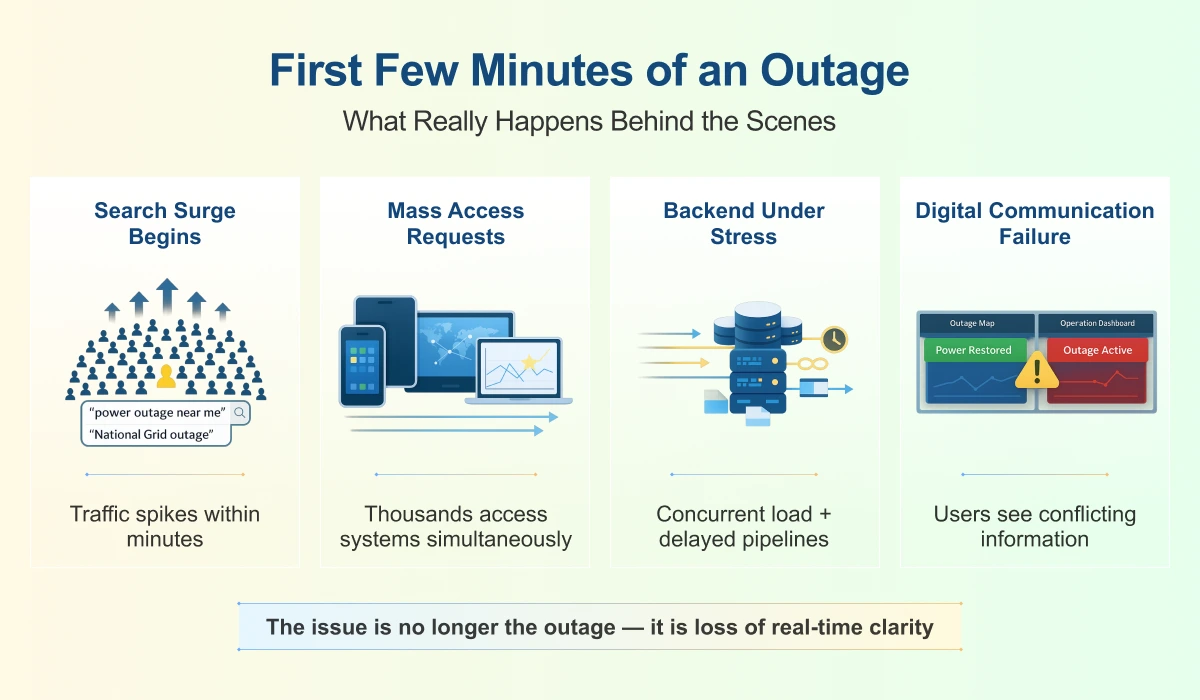
Search behavior around storms and outages has shifted in both speed and intensity. Terms such as National Grid outage, Eversource outage, and power outage near me now spike within minutes of weather alerts or grid instability. People are not waiting for official updates or traditional communication channels. They search immediately, often at the exact point when systems are already under pressure.
This behavior turns search activity into an immediate demand signal. It shows when answers are needed, how urgent the situation becomes, and which sources are expected to respond first. For utilities and customer-facing enterprises, this creates a new operating reality. They are managing not just the event itself, but a surge in digital traffic, information requests, and the need for timely answers.
Physical Disruption Now Creates a Digital Experience Test
A power outage used to be judged by restoration time alone. Today, it is also judged by the quality of communication around it. The moment service is interrupted; residents turn to digital systems for a usable, accurate view of what is happening.
When power outage maps stall, dashboards lag, or updates remain unclear, frustration quickly shifts from the physical event to the digital experience around it.
This is where power outage events begin to function as real-time stress tests for digital systems. A storm may impact the grid first, but it also drives sudden load across websites, mobile platforms, outage dashboards, and internal response systems. Search spikes tied to National Grid or Eversource outage do not just reflect infrastructure strain. They expose whether backend systems can handle surge traffic, maintain synchronized data, and deliver consistent live updates under pressure.
Most systems are designed for steady traffic, not sudden concurrency spikes. This is where real-time data consistency becomes the first point of failure.
What This Surge Reveals About Digital Behavior
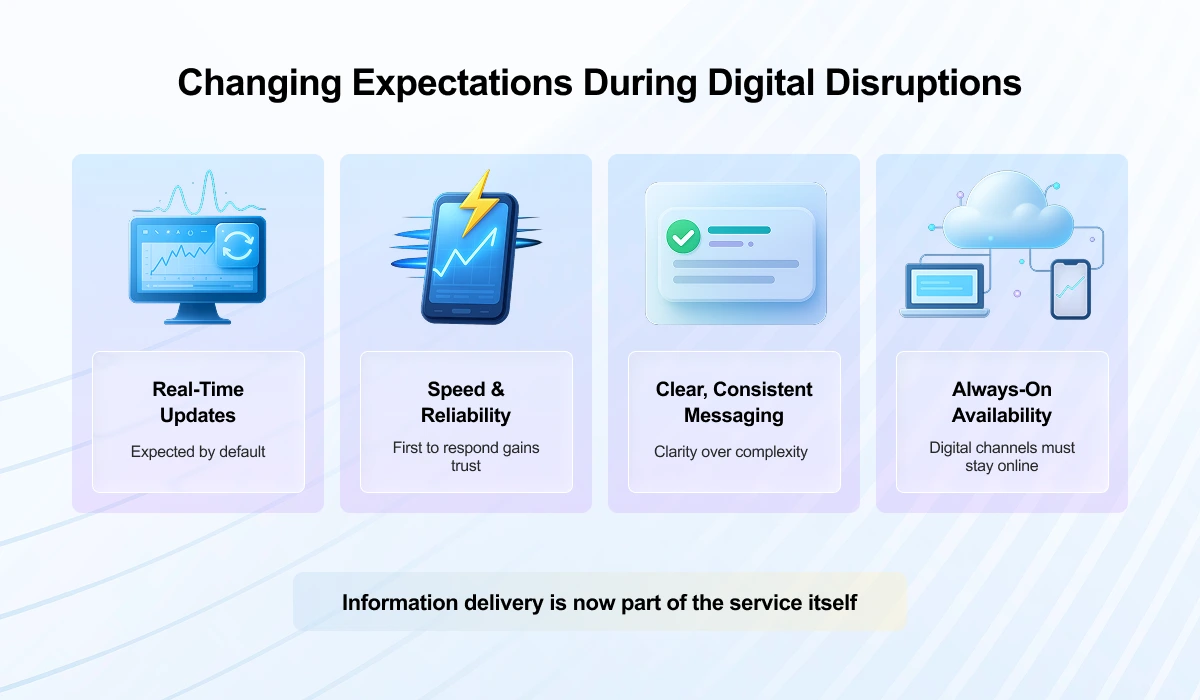
The rise in outage-related searches highlights a clear shift in how expectations form during disruption.
- Real-time information is now expected by default. People look for continuous updates as situations evolve, not delayed summaries after stabilization.
- Trust forms around responsiveness. In uncertain moments, the system that responds quickly and communicates well becomes the source residents rely on.
- Clarity matters more than complexity. A single, reliable view that explains what happened, what is impacted, and what to expect next becomes critical.
- Being offline is no longer acceptable, even during real-world disruption. Digital channels are still required to remain available when it matters most.
In moments of disruption, there is no distinction between system failure and communication failure. Both are experienced the same way.
What Enterprises Should Learn from This Shift
The same pattern extends far beyond utilities. The same demand now apply to logistics delays, airline disruptions, supply chain interruptions, healthcare access, and field-service operations. Whenever something changes in the real world, digital systems are relied on to explain it immediately.
Meeting that expectation requires more than front-end improvements. It depends on how systems are structured behind the scenes. Real-time data pipelines, event-driven workflows, and coordinated system behavior determine whether information reaches the right audience in time and in a usable form.
CES addresses this challenge by helping enterprises design systems that remain responsive during high-pressure moments. This includes enabling real-time data movement across systems, aligning workflows to reduce delays, and improving visibility across platforms so that information remains consistent even during sudden demand spikes.
We also focus on eliminating the gap between system updates and user visibility by ensuring that operational data is processed, synchronized, and surfaced without delay. The outcome is not just better system performance. It is the ability to maintain clarity and control when external events create uncertainty.
Why This Matters in 2026 and Beyond
The surge in searches for National Grid, National Grid power outage, Eversource outage, and power outage near me reflects a broader shift in digital expectations. Consumers want real-time visibility from every system they interact with.
This expectation extends across industries. Customers expect delivery updates without delay; travelers look for immediate disruption alerts, and service users rely on accurate status information when systems fail. In each case, organizations are evaluated not only by what went wrong, but by how clearly they communicate what happens next.
Real-time communication now sits at the center of product experience, operational resilience, and brand trust.
Information Is the New Power
When the power goes out, what people look for first is not just restoration. It is a reassurance. They want timely information, dependable guidance, and confidence that the situation is understood.
This is what outage-search surges actually reveal. In uncertain moments, trust is built through visibility. Organizations that provide clear, current, and reliable information will stand apart, even when the disruption itself is outside their control.
In a world shaped by real-time expectations, information has become a core part of customer experience, operational credibility, and business resilience.
Because when uncertainty rises, information becomes the first point of trust.