
AI Guardrails: Why Enterprise AI Needs Control Before Intelligence
AI guardrails emerge from a pattern most enterprises haven’t fully recognized yet. For decades, we built systems to compensate for human behavior. Not because people lacked intelligence, but because intelligence alone was never reliable. We infer, we assume, and act with partial information, then justify it after the fact. Enterprise technology was designed to prevent that from turning into operational risk.
- ERP systems don’t trust intent. They enforce rules.
- Finance systems don’t rely on judgment. They validate thresholds.
- Access controls don’t assume good behavior. They restrict it.
That structure is the reason large organizations function at scale. Now AI is being introduced into that same environment. And for the first time, the system is being asked to rely on something that does not operate on certainty. This is where the tension begins.
AI did not remove uncertainty. It scaled it
There is a belief, still surprisingly common, that better models will reduce error to the point where control becomes less important. That belief misunderstands what AI does.
AI does not reason the way enterprise systems enforce logic. It predicts. It generates the most likely outcome based on patterns it has learned. That outcome can be correct. It can also be incomplete, misinterpreted, or entirely wrong while still sounding confident.
The issue is not that AI makes mistakes. Every system does. The issue is that AI does not know when it is making one.
When a human is uncertain, there are signals. Hesitation, Escalation, and Context. When a deterministic system encounters something invalid, it stops. AI does neither. It continues forward with the same level of confidence regardless of accuracy.
That behavior is manageable when AI is used for drafting, summarizing, or recommendations. The moment AI is allowed to interact with enterprise systems, the impact changes. The error does not stay in text; it becomes an action.
The shift most enterprises are underestimating
AI is no longer confined to generating responses. It is increasingly being connected to systems where it can:
- retrieve enterprise data directly from internal platforms
- trigger workflows across integrated applications
- initiate API calls that affect live operations
- support financial, operational, or customer-facing decisions
At that point, the conversation changes. It is no longer about whether the output is correct. It is about whether the action should have happened at all.
That distinction is where many enterprise AI strategies begin to drift. Once AI moves from answering to acting, the system is no longer interpreting information. It is executing outcomes.
Where architecture starts to break
Most implementations today try to control AI behavior inside the model.
Prompts are refined, and instructions are layered. Guardrails are described to the system. It creates the impression that boundaries exist, but describing a rule is not the same as enforcing it.
If an AI agent has access to a platform, it can attempt actions regardless of how carefully it has been instructed. Instructions guide behavior. They do not prevent execution.
This is the same mistake early internet systems made before firewalls existed. Trusting endpoints to behave correctly instead of enforcing what was allowed to pass through.
Enterprise systems never worked that way. They separate intent from execution. They validate before they allow. When AI is embedded without that separation, control does not fail immediately – it erodes.
Why AI needs a referee, not just capability
There are two fundamentally different types of systems operating inside enterprises.
The first are deterministic systems. ERP, CRM, HCM, and data platforms. These systems hold verified data and enforce business rules. They do not infer, do not approximate, and apply logic consistently.
The second is AI. A probabilistic layer that reasons, predicts, and optimizes for outcomes.
The question is not whether these systems should work together. They already are. The question is which one governs the other.
If AI operates through enterprise systems, where every action is validated against rules, the organization maintains control. The system behaves as expected, and the logic layer remains intact.
If enterprise rules are pushed into AI and expected to be followed through prompts or alignment, the system becomes dependent on a probabilistic engine to enforce deterministic constraints.
This is structurally flawed. Optimization systems do not enforce limits. They find paths around them.
The emergence of AI policy firewalls
This is where a new layer becomes essential. As networks evolved, firewalls were introduced to inspect and control what moved across boundaries before anything was allowed through.
AI is reaching that same inflection point.
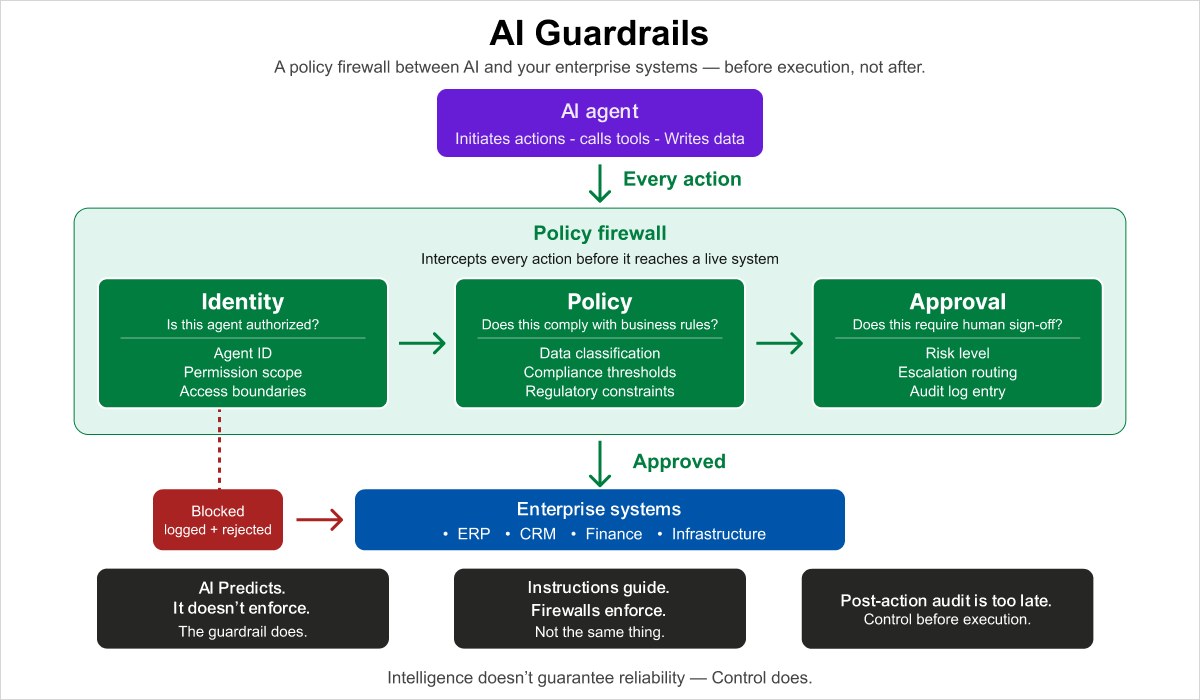
A policy firewall sits between the AI and the enterprise environments it interacts with. Every action is intercepted and checked before it reaches a live system.
At that point, the system asks:
- Is this action authorized for this agent?
- Does it comply with enterprise policy and data constraints?
- Does it require validation or approval before proceeding?
Only after those conditions are satisfied does the action move forward. This is not moderation. It is enforcement, and that distinction matters.
Traditional controls focused on filtering outputs. Policy firewalls focus on controlling actions. They do not just evaluate what AI says but govern what AI does.
From oversight to control
Enterprises already have governance frameworks. Policies exist, and compliance structures are in place.
The gap is not the absence of governance. It is the point at which governance enters the flow.
If policies are checked after execution, they serve as audit. If they are applied before execution, they serve as control.
AI changes the cost of that distinction.
When systems operate at scale and speed, post-action validation is too late. A single incorrect instruction can trigger thousands of downstream actions across connected workflows.
Control has to move closer to execution.
A policy firewall turns governance into a runtime mechanism. Every action is evaluated in context. Every decision is traceable, and every exception is visible.
That is how enterprises regain control without slowing down adoption.
The role of identity in the agent era
As AI systems begin to act more like digital workers, identity becomes a critical layer of control.
Every human inside an enterprise operates within defined permissions. Access is controlled, actions are logged, and responsibilities are assigned.
AI agents need the same structure.
Each agent must have a defined identity. What it can access, what it can modify, and what requires approval. Without that, the system cannot distinguish between allowed and unauthorized actions.
This is already becoming essential in environments where AI interacts with financial systems, customer data, or infrastructure.
The model may generate the action, but the system determines whether that agent is allowed to perform it.
What failure looks like
Failures in enterprise AI are rarely immediate or obvious. They show up as gradual inconsistencies.
- Data accessed in the wrong context.
- Actions executed without sufficient validation.
- Decisions moving forward without clear traceability.
The system continues to operate, but the discipline that once governed it begins to weaken.
Because enterprise systems are interconnected, that weakness spreads. A single incorrect action does not stay isolated. It moves across workflows, affects multiple layers, and creates downstream impact that is difficult to unwind.
AI accelerates the movement of both value and error. Without a control layer, there is nothing to contain either.
The architecture that holds
The architecture that works is straightforward, but it requires discipline. Enterprise platforms remain the source of truth. They hold data, enforce rules, and define how the business operates.
AI operates as a reasoning layer. It interprets, synthesizes, and generates outcomes.
Between the two sits a guardrail layer. A policy enforcement mechanism that guarantees every interaction is validated before execution.
That separation matters because it removes the expectation that AI will regulate itself. It restores the system’s ability to enforce constraints independently of the model. It also allows organizations to scale AI without compromising how their environments function.
What this means for enterprise strategy
There is a tendency to view existing enterprise infrastructure as something AI will replace.
It is the wrong conclusion.
Enterprise systems are not barriers to AI. They are the reason AI can operate safely end-to-end.
They encode years of operational knowledge. Approval workflows, compliance thresholds, access controls. These are not configurations. They are accumulated decisions shaped by real-world constraints.
AI does not replace that knowledge. It depends on it. The organizations that succeed will not be the ones that move fastest to deploy AI. They will be the ones that define how AI operates within their environments.
How CES approaches enterprise AI guardrails
At CES, AI is integrated through governed enterprise pathways, where access, execution, and traceability are designed into the architecture rather than added after deployment.
AI operates within defined boundaries. Data access is controlled. Actions are validated before execution. Decision pathways remain traceable.
This ensures AI strengthens how enterprise platforms function rather than bypassing them.
In environments such as infrastructure, finance, and enterprise platforms, where the cost of error is immediate, this approach is critical. It allows organizations to move faster without introducing instability.
The objective is not just to make AI work. It is to make it work reliably.
The decision every enterprise is making now
Enterprises are no longer deciding whether to adopt AI. They are deciding how it will operate.
Whether AI functions inside a system that enforces discipline, or outside of it, where behavior is assumed rather than verified. That decision will determine whether AI becomes a source of advantage or a source of risk.
Because intelligence does not guarantee reliability. Control does.