
7 Things Enterprises Must Get Right to Scale Agentic AI
A strong Agentic AI demo can create the wrong kind of confidence. The workflow looks smooth, the model responds well, and the business value feels obvious to everyone in the room. Then the harder questions surface. Which systems can the agent access? Who approves its actions? What happens when the agent pulls the wrong data? How do teams monitor quality, security, and reliability once it moves to production?
That is where many initiatives slow down. McKinsey reports that around 65–70% of organizations are experimenting with generative AI, yet most remain far from enterprise-wide scale. BCG reinforces that gap, finding that only 26% of firms have moved beyond pilots to create measurable business value from AI initiatives. In most cases, the constraint is not model quality, but the ability to operationalize AI across real environments.
Agentic AI changes the unit of value from outputs to actions. Once AI agents begin retrieving enterprise data, triggering workflows, calling APIs, and coordinating tasks across systems, the conversation shifts from experimentation to operational discipline. This is where Enterprise AI starts to become real. To move from promising pilots to reliable production outcomes, enterprises need a few foundations in place. These are the seven we believe are most critical.
1. Treat the demo as proof of interest, not proof of readiness
A successful demo proves that the concept can work. It does not prove that the system is ready for enterprise deployment.
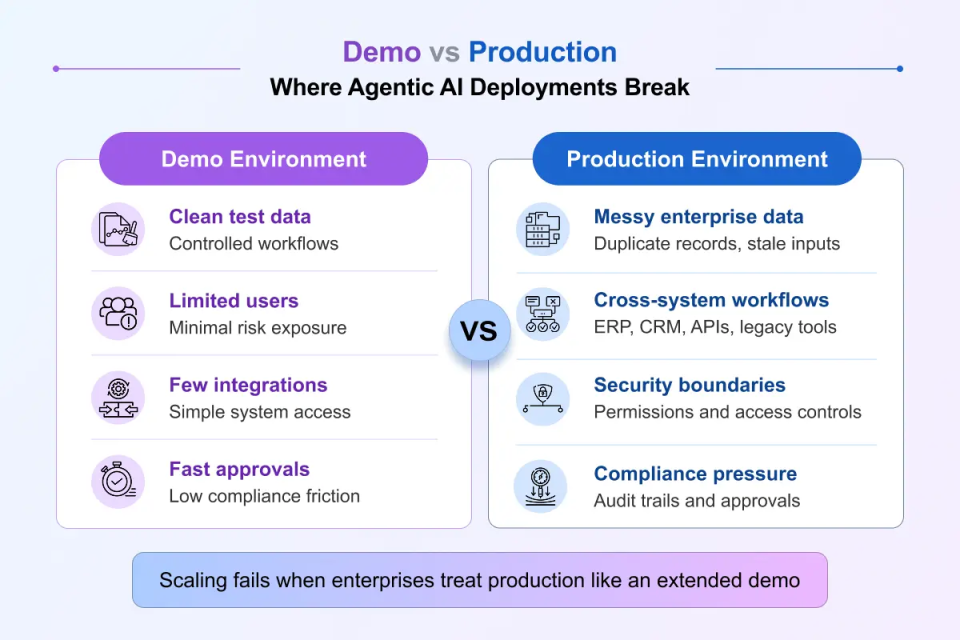
Demo environments are controlled by design. The data is cleaner, workflows are narrower, and failure paths are limited. Production environments introduce messy variables that demos rarely account for, including inconsistent data quality, shifting permissions, operational dependencies, compliance reviews, and accountability for failure.
This is where many teams realize they built something impressive but not something durable. The real question is not whether the agent completed the task once. It is whether it can do the work repeatedly, under pressure, with the right approvals, visibility, and guardrails. That is the standard for Enterprise AI.
2. Fix the data layer before agents touch critical workflows
Most Agentic AI projects run into trouble at the data layer before they hit any model limit.
Enterprise data often sits across disconnected systems, business units, legacy applications, and restricted environments. Some records update in real time, while others refresh in batches. Many organizations still struggle with duplication, inconsistent ownership, and outdated access policies.
AI agents amplify those weaknesses because they act on what they retrieve.
A supply chain agent working with delayed inventory data may create planning errors. A finance agent pulling inconsistent records can create approval issues that ripple across departments. A customer service agent using outdated information damages trust instantly.
Before scaling AI deployment, enterprises need clear answers to practical questions:
- Which data sources are trusted?
- Which systems provide real-time access?
- What permissions should each agent have?
- What data should never be exposed?
If those questions remain unresolved, scaling simply spreads bad decisions faster.
3. Start with workflows that are repetitive, measurable, and easy to govern
Organizations often chase high-profile automation projects while overlooking simpler workflows that create faster returns. Repetitive administrative tasks, document routing, internal knowledge retrieval, developer enablement, compliance preparation, onboarding workflows, and approval coordination often produce stronger early results because they are easier to measure and control.
These workflows typically have:
- clear inputs
- predictable outcomes
- lower operational risk
- defined human checkpoints
That makes them strong starting points for Production AI. When teams see repetitive work disappear without sacrificing quality, trust builds quickly. Those early wins often create the momentum needed for broader Enterprise AI adoption.
4. Build orchestration before pushing for autonomy
Many companies still treat the model as the entire system. That view does not hold up in production.
The real architecture sits around the model. Production-ready AI agents need task orchestration, workflow sequencing, memory management, fallback logic, tool permissions, API coordination, and clear escalation paths when confidence drops.
Without orchestration, autonomy becomes fragile. An agent may generate the right answer and still fail when it must coordinate multiple actions across systems. Another may complete the first task correctly, then break when a downstream dependency changes.
Strong AI systems behave more like disciplined software systems than intelligent assistants. They break work into smaller tasks, manage state carefully, route actions properly, and recover when something goes wrong.
That operational discipline is what separates scalable systems from fragile demos.
5. Let subject matter experts define what “good” means
Engineers can build the system, but they should not be the only people defining domain truth.
That belongs to the people who live with the workflow every day. In finance, that means teams that know which exceptions matter and which ones do not. In operations, that means the people who understand why a process breaks at step four and not step one. In engineering, that means the people who can tell whether generated output is useful inside the SDLC.
This is one of the biggest differences between a pilot and enterprise-ready AI. In pilots, teams often rely on intuition. In production, that is not enough. Enterprises need curated test cases, golden datasets, scoring logic, and clear acceptance criteria. More importantly, they need subject matter experts involved in defining those standards.
If SMEs are not in the loop, the system may still work technically. It just will not earn trust.
6. You cannot scale what you cannot observe
Traditional monitoring can tell you whether a request was completed, but not whether the outcome made sense.
That is a critical gap in Enterprise AI operations. An agent may return a clean response, execute a tool call successfully, and still produce the wrong outcome. Standard telemetry captures system health. It does not capture reasoning quality, tool misuse, drift, or bad decisions.
This is why Production AI requires deeper visibility into:
- prompt traces
- tool usage logs
- model confidence signals
- output drift
- exception patterns
- rollback paths
Teams need to know more than whether the system responded. They need to know whether it responded correctly, consistently, and within policy.
If you cannot see how an agent reached its result, you cannot improve it with confidence. If you cannot trace why it acted, you cannot defend it in a regulated environment.
7. Governance must sit inside runtime, not outside it
This is where many AI strategies lose operational sharpness.
Enterprises often have governance frameworks, policy documents, and review processes. That is useful, but it is not enough if those controls sit outside execution.
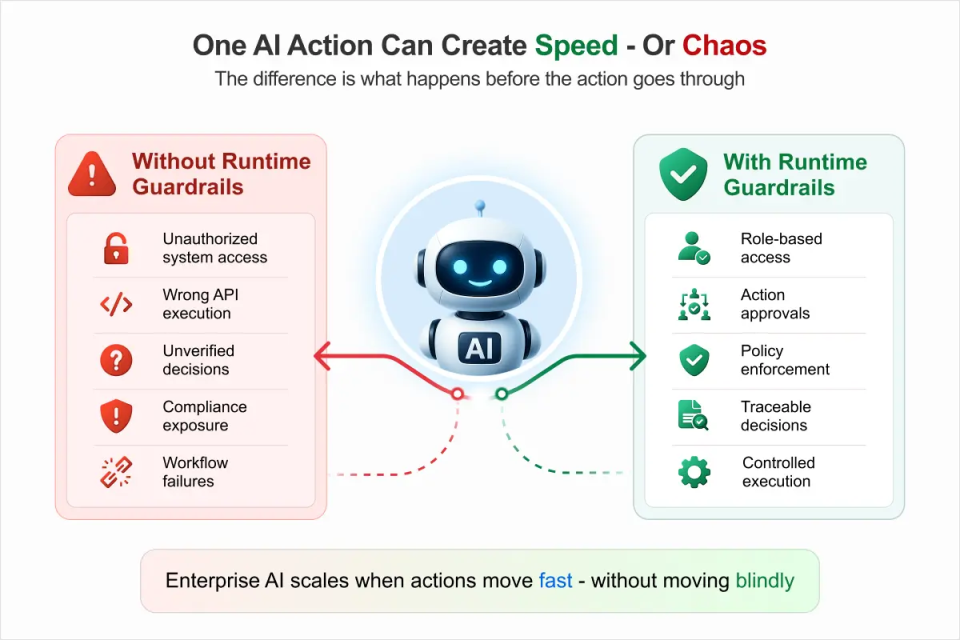
Once AI agents start acting across systems, governance has to operate at runtime. It must determine what the agent can access, which tools it can invoke, what approvals are required, and where a human needs to step in. This is where AI guardrails move from concept to architecture.
A policy firewall, approval layer, or runtime governance mechanism changes the operating model. Instead of reviewing behavior after the fact, the system checks the action before it goes through. That is how enterprises reduce risk without slowing everything down. It is also how they make AI agents fit inside business environments where trust depends on traceability, permissions, and controlled execution.
The organizations that scale successfully will not be the ones that built the flashiest demos. They will be the ones that brought discipline to data, workflows, observability, governance, and operating design before AI agents were given too much freedom.
Agentic AI can deliver durable ROI, but long-term value comes from knowing where the agent fits, what it is allowed to do, how its performance is measured, and how it is governed once it starts working inside live systems.
If your teams are trying to move from pilots to enterprise-ready AI, this is the stage where architecture, runtime controls, and workflow design begin to shape outcomes. CES works with organizations to build Agentic AI systems designed for scale, governance, and operational reliability.